Air Force Seeks $500M+ for Armed Tanker Defenses Amid Hormuz Blockade Escalation
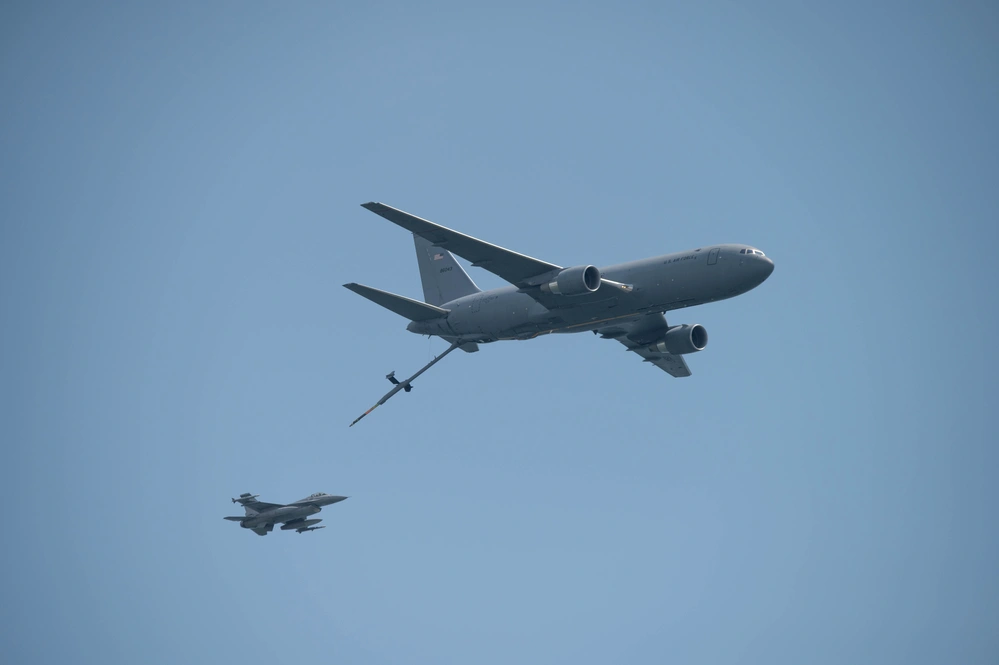
The Hormuz blockade (90% shipping collapse, 1.8M barrels/day trapped) has forced Trump into direct Navy escort operations (Project Freedom), which Iran has explicitly threatened to attack. Armed tankers directly enable sustained air operations in that environment — without them, the Air Force cannot maintain the sortie rate needed to enforce the blockade or strike Iranian targets if negotiations collapse.
This converts a logistics problem into a force-structure problem: the Air Force is now buying defensive firepower as a prerequisite for blockade enforcement, not as a standalone capability upgrade.
This is a direct hedge against the Hormuz blockade and Iran threat environment now live.
KC-135s and C-130s operating in the Gulf theater are currently undefended against the drone and missile density Iran has demonstrated — Russia is pumping 1,600 attack drones weekly into Ukraine, and Iran has comparable arsenals. Without active defenses, every tanker sortie into the theater becomes a casualty risk, which constrains sustained air operations against Iran or in support of regional allies.
The $500M+ figure suggests this is not an incremental upgrade but a full-system retrofit — sensor fusion, fire control, and kinetic or directed-energy countermeasures. If the Air Force is asking for this NOW, it's pricing in a near-term scenario where these aircraft operate in a contested Hormuz environment, not a hypothetical one.
The vendors likely to win are Raytheon (AMRAAM integration), Northrop (EW suites), or Lockheed (fire control). The real question is whether this accelerates the retirement of legacy tanker fleets or forces a major C-17/KC-46 retrofit that wasn't in the FYDP.
Is the $500M+ figure a single-year request or a total program cost through FY31? If it's annual, this is a $3B+ commitment — materially different from a modest upgrade. The article doesn't specify.
Fault Lines
Strategic intelligence, synthesized daily — with a public track record. Every call graded against what actually happened.