General Atomics selected for Marine Corps loyal wingman autonomy trials
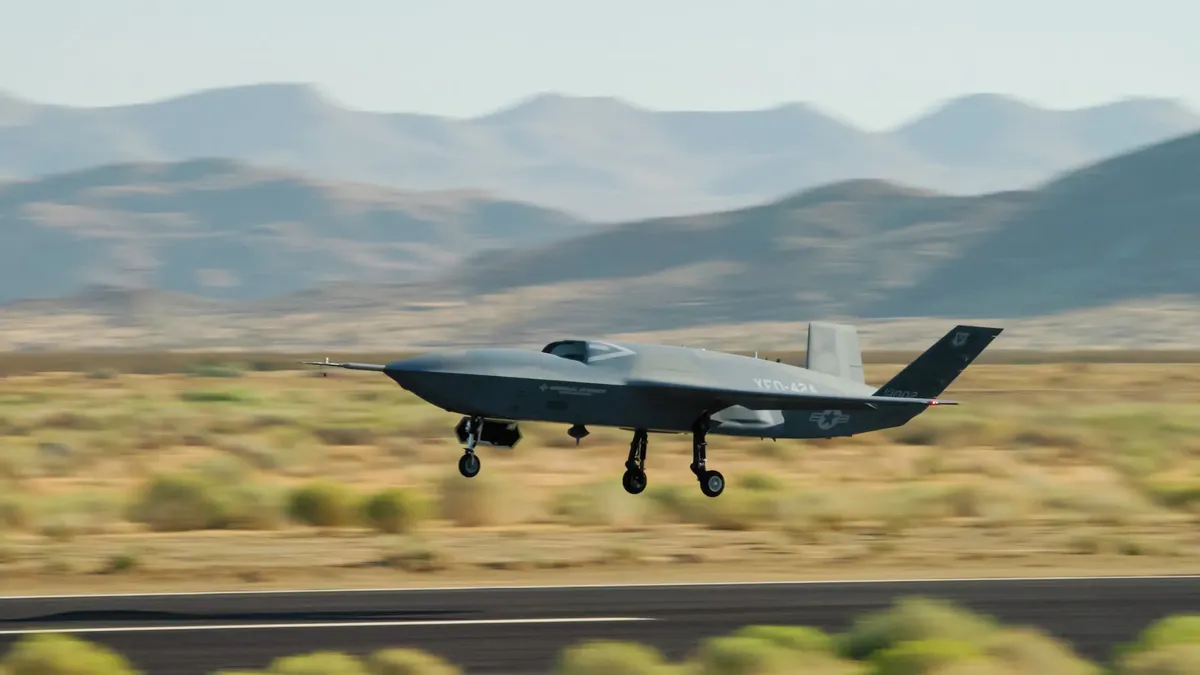
Dual-pillar relevance: (1) Power Projection — CCA is core to Marine Corps force design for contested environments; selecting a proven platform accelerates operational capability development. (2) Market Forces — General Atomics gains competitive advantage in the emerging loyal wingman market; success here could justify higher valuation for future CCA production contracts (estimated multi-billion dollar opportunity if scaled across services).
The selection does not directly alter export controls or geopolitical friction, though CCA autonomy tech will face scrutiny in future foreign military sales decisions.
This signals General Atomics as a primary autonomy development partner in the Marines' CCA effort, a critical near-term pathway for demonstrating human-machine teaming at scale.
For General Atomics, this represents validation of the YFQ-42A platform and likely positions the company for follow-on development and production work if trials succeed. The Marines gain a proven airframe for testing integration challenges—sensor fusion, flight control handoff, communication latency—before committing to full-scale wingman procurement.
However, this is a test-and-evaluation contract, not a production award; success is contingent on demonstrating reliable autonomous flight alongside legacy fighters, which remains technically unproven at operational tempo.
The article does not specify: (1) contract value or duration, (2) whether this is a sole-source selection or competitive award, (3) timeline for trials or go/no-go decision points, (4) which Marine fighter platforms (F/A-18, F-35) will be used for integration testing, or (5) whether other primes (Kr...
Fault Lines
Strategic intelligence, synthesized daily — with a public track record. Every call graded against what actually happened.