Rosstat Leak Exposes 450,000 Russian Deaths in Ukraine; War Now Fourth Leading Cause of Death
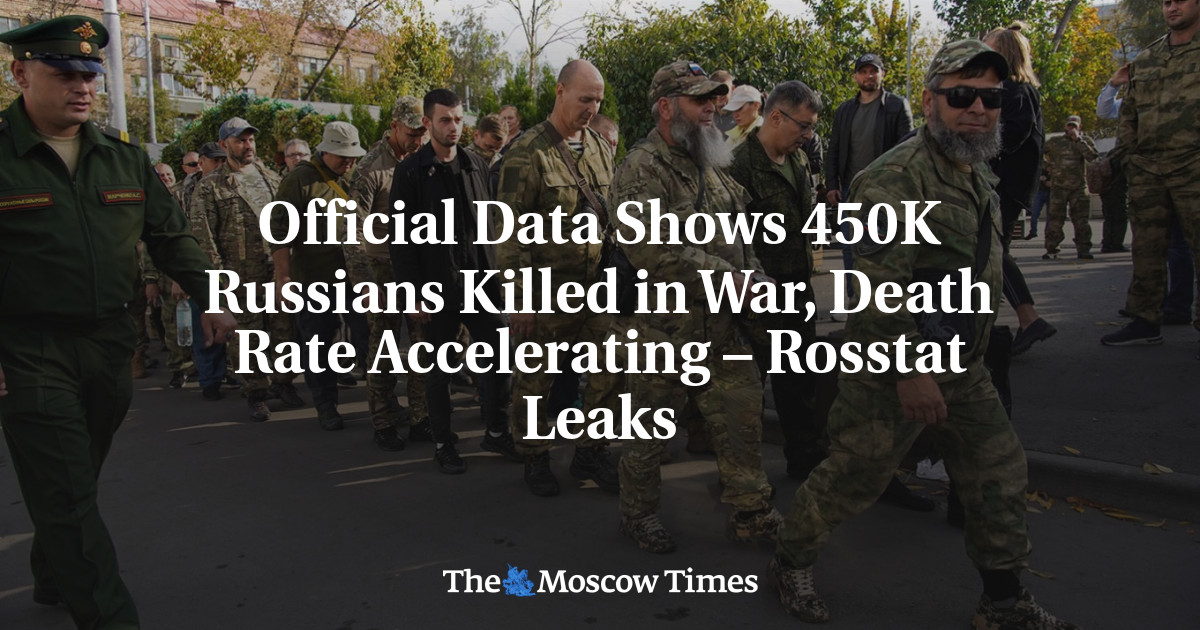
The Belarus Cyber Partisans and Silent Crow breached Rosstat between October 29 and November 1, extracting official Russian casualty data that quantifies 450,000 deaths—military and civilian combined—since the 2022 invasion began. This figure excludes missing-in-action personnel and the 27,000 foreign fighters cited in the leaked materials, meaning the true toll exceeds what Rosstat's database captured.
The Moscow Times reports the 450,000 as official Rosstat calculation; the British Defense Ministry's separate assessment of over 500,000 killed suggests either Rosstat undercounts or uses a narrower definition (the source material does not clarify which).
The constraint Rosstat's data exposes is geometric: if 72 percent of deaths concentrate in Donetsk and the war has become Russia's fourth leading cause of death nationally, then the casualty-to-terrain ratio has inverted since 2022.
Janis Kluge of the German Institute for International and Security Affairs states the war "has never been more deadly than it is right now," placing acceleration in the present tense—a claim the leaked data structure supports but the source material does not quantify with month-on-month comparisons.
Moscow's silence on losses since September 2022 functioned as a political constraint: deniability required no official figure to contradict. Rosstat's leaked database collapses that option by establishing a state-source baseline that domestic Russian audiences can now reference against recruitment notices, regional conscription announcements, and casualty lists circulating on social media.
The second-order effect runs through the ethnic republics and conscription pools already identified as depleted: if regional military commissariats must now justify mobilization quotas against proof that their previous cohorts suffered 450,000 losses concentrated in grinding pocket warfare, the political cost of the next recruitment wave rises sharply.
Ukraine's intelligence services gain a secondary advantage—cross-referencing leaked names against their own casualty tracking and unit rosters produces a high-confidence map of which Russian formations are at effective strength and which reserve echelons rotate next, collapsing the fog of war around force composition.
The Kremlin's response choice—discredit Rosstat data or reframe 450,000 as acceptable attrition—signals whether Moscow believes the domestic narrative still holds or has shifted to cost-absorption messaging.
Rosstat's leaked casualty database breaks four years of Kremlin silence on wartime losses and establishes 450,000 deaths as an official Russian figure, not a Western estimate—a distinction that shifts the burden of proof onto Moscow to explain why attrition continues accelerating despite territorial stagnation.
The concentration of 72 percent of deaths in Donetsk indicates that Russia's current offensive tempo has hit a hard constraint: each kilometer gained now costs exponentially more blood than 2022-2023 advances, a trajectory that will surface in recruitment and mobilization politics within 18 months as regional conscription pools deplete.
Ukraine's intelligence services can now cross-reference the leaked names against their own casualty tracking to produce a high-confidence targeting map of depleted Russian units and incoming reserve rotations, collapsing the fog of war around force composition.
The Kremlin's response—whether it discredits Rosstat or reframes 450,000 as acceptable losses—signals whether Moscow believes the domestic narrative still holds or has shifted to cost-absorption messaging. Watch for regional military commissariat announcements of new conscription quotas and the Kremlin's public statements on Rosstat's institutional credibility within the next 30 days.
Does the Kremlin respond to the leak by discrediting Rosstat data or by acknowledging the figures and reframing them as acceptable losses? The choice signals whether Moscow believes the domestic narrative still holds or has shifted to cost-absorption messaging.
Fault Lines
Strategic intelligence, synthesized daily — with a public track record. Every call graded against what actually happened.