Royal Navy Launches Four Nyan Strike Drones From HMS Queen Elizabeth; All Hit Targets
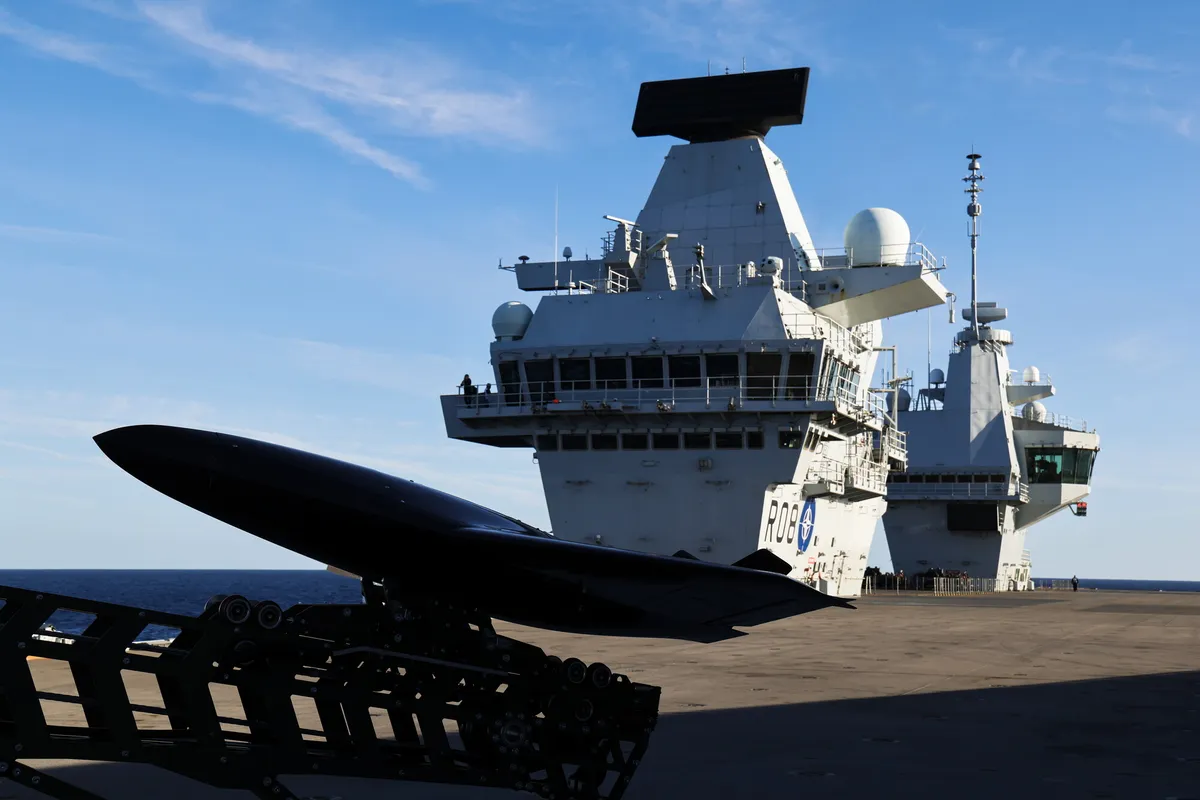
The integration of affordable, scalable strike mass into the carrier's organic air wing reduces dependence on crewed Super Hornet or F-35 sorties for standoff strike roles — a significant margin-of-effort shift when UK carrier airwings are already constrained by pilot availability and aircraft maintenance rotations.
If Nyan moves from trials to fleet deployment, it absorbs launch capacity that would otherwise demand F-35B or Merlin sorties, freeing those platforms for air defense or anti-submarine work.
The second move: Callen-Lenz's £5 million contract is seed funding; the real question is whether the MoD budgets for the production scale (dozens per year) that would make Nyan a force-shaping system rather than a capability demonstrator.
HMS Queen Elizabeth now has a proven strike drone payload, which reshapes the Carrier Strike Group's lethality calculus without requiring additional crewed aircraft procurement.
The Royal Navy is moving from theoretical hybrid-force concepts to operational validation — this test directly informs whether Maritime Aviation Transformation includes organic one-way effectors as a core capability, not an add-on.
Watch the Defence One-Way Effector programme's next tranche decision (expected in Q2 2027) to see whether this success triggers production orders beyond the £5 million Callen-Lenz contract already awarded.
Does the Royal Navy plan to integrate Nyan into the permanent CSG loadout, or is this a single-platform experiment? The article doesn't specify how many additional drones beyond the four tested are on order or funded.
Fault Lines
Strategic intelligence, synthesized daily — with a public track record. Every call graded against what actually happened.