Three Carriers Deployed to Middle East for First Time Since 2003; Hormuz Enforcement Escalates
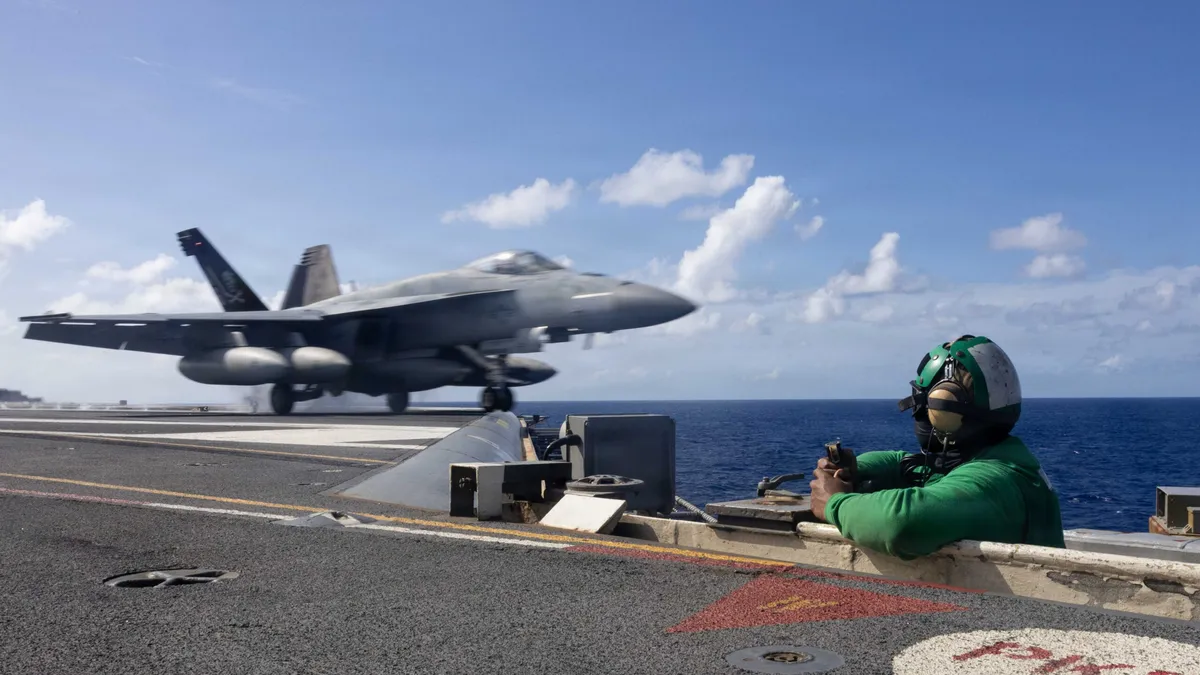
The three-carrier deployment forces a zero-sum trade in US naval capacity: each month the carriers remain in the Persian Gulf is a month they are not forward-deployed in the Indo-Pacific, where Japan (accelerating autonomous defense), Australia (buying Japanese frigates), and South Korea are all signaling reduced faith in US commitment.
China will interpret the Hormuz commitment as a window to test Taiwan's defenses or contest the First Island Chain without immediate carrier response.
This is not a symbolic show of force — it is a material escalation of the blockade into a sustained enforcement posture.
Three carriers represent roughly 300 strike aircraft and 30,000 sailors committed to a single theater for months, not weeks. The last time the Navy attempted this scale of commitment was 2003 in Iraq, and it burned through maintenance accounts and delayed carrier rotations for years.
Trump's $1.5T FY27 budget request (42% increase) now has a concrete consumption schedule: sustaining three CSGs in the Persian Gulf burns through carrier operating budgets, accelerates depot maintenance backlogs, and forces deferred maintenance on Atlantic and Pacific fleets.
This directly competes with the Japan-Australia frigate program (A$10B), the EU's Article 42(7) activation, and Germany's rearmament timeline for available shipyard capacity and skilled labor. If Iran continues attacks during the ceasefire (as it has, per prior signals), the Navy moves from blockade to sustained combat operations — at which point the carrier force becomes the primary instrument, not a deterrent.
The three-carrier deployment also signals to China and Russia that the US is committing carrier capacity to the Middle East that cannot simultaneously deter Taiwan or contest the Arctic.
How long is CENTCOM authorized to sustain three CSGs in theater before the Navy breaks the rotation model and begins extending deployments beyond 9-month cycles?
Fault Lines
Strategic intelligence, synthesized daily — with a public track record. Every call graded against what actually happened.