Poland Receives First Three F-35As; 32-Aircraft Fleet Deployment Begins
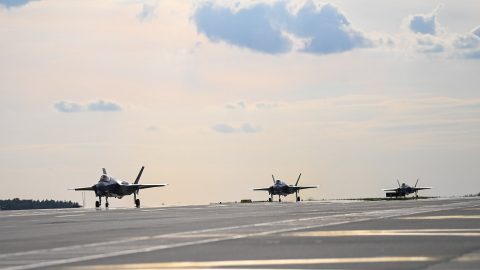
The F-35 arrival is incremental procurement confirmation, not a strategic surprise — but it arrives during active Russian escalation (Oreshnik strikes, refinery attacks) that has already forced NATO air commands to reassess sortie generation requirements.
If Poland achieves operational F-35 capability by Q4 2027 (roughly 18 months from now), it fills a critical gap in NATO's ability to contest Russian air operations over the Baltic. However, the delivery cadence now competes directly with Romania and Bulgaria's own F-35 orders in the same production queue.
Any delay in Polish deliveries cascades into Central European air gaps that USAF will have to backfill with rotational deployments — adding sustainment costs to EUCOM's O&M budget.
Poland's F-35 arrival accelerates NATO's eastern flank air modernization and locks in 18-24 month delivery cadence that will strain Lockheed's production line through 2028.
Deputy PM Kosiniak-Kamysz's public ceremony signals Warsaw is prioritizing visible deterrence posture against Russian air operations in the Baltic region — directly relevant to the Oreshnik strike on Ukraine two days prior and ongoing refinery targeting that signals Moscow's willingness to escalate.
Poland's 32-aircraft commitment represents $6.5B in total program value; the arrival of the first three units confirms that Lot 15 production is on track, which means Lockheed's Fort Worth facility must sustain 12-15 aircraft deliveries per quarter through 2028 to meet all allied commitments (Poland, Romania, Bulgaria, Hungary, Slovakia). Watch the Q3 2026 production rates and any schedule slippage announcements.
Does Poland's two-base distribution plan (specific bases not named in article) align with NATO's revised Eastern Europe air defense architecture, or is this independent of the broader alliance posture review?
Fault Lines
Strategic intelligence, synthesized daily — with a public track record. Every call graded against what actually happened.