Army Adapts Small-Arms, Mortar, Artillery Systems to Counter Drone Threats
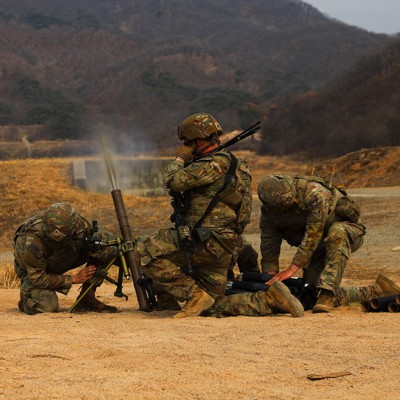
The shift of kinetic ammunition toward anti-drone roles competes with existing small-arms and artillery demand in the Middle East theater. If small-caliber and 155mm rounds are being diverted to counter-UAS missions, resupply rates for ground maneuver units decline—forcing either expanded procurement (increasing ammunition industrial base load) or operational constraints on conventional fire.
This directly cascades into the sustained wartime footing already signaled by the 50,000+ troop deployment and DoD-Lockheed PrSM acceleration: the conflict is not just consuming advanced munitions, but also forcing repurposing of legacy inventory, which signals that consumption rates exceed peacetime production capacity.
This reflects an operational reality already evident in the Middle East conflict: drone swarms and small UAS are outpacing air defense systems designed for larger targets, and ammunition consumption in contested airspace is rising.
Rather than waiting for new air defense platforms, the Army is repurposing existing inventory and fire control systems.
The implication is twofold: (1) ammunition demand will increase across small-caliber and indirect-fire categories as these systems shift from anti-personnel to anti-air roles, and (2) this is a stopgap, not a solution—it suggests air defense modernization timelines are slipping relative to the threat.
Ammunition producers (General Dynamics, Northrop Grumman, Lake Shore Industries) and fire control integrators will see near-term volume increases, but the signal indicates the Army views current air defense architecture as insufficient.
The article does not specify which platforms are being modified, whether this is doctrine-only or involves hardware changes, estimated ammunition consumption rates, or whether this reflects lessons from active operations in the Middle East.
Fault Lines
Strategic intelligence, synthesized daily — with a public track record. Every call graded against what actually happened.