Navy Plans 450-Hull Unmanned Surface Vessel Fleet by 2031; Industrial Capacity Unspecified
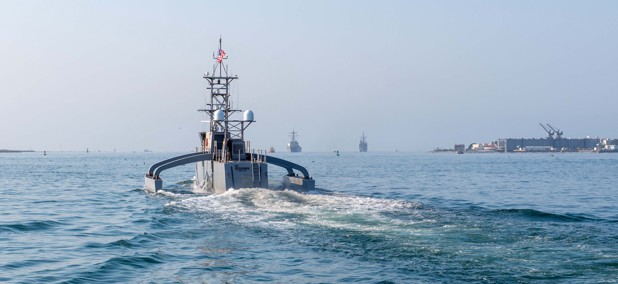
The 450-hull number is a fleet architecture target, not a procurement plan. If the Navy splits production across multiple yards (likely), each gets a smaller annual commitment — making unit costs rise and lead times extend.
Austal, which dominates small combatant production, built 13 Cyclone-class coastal combat ships over 13 years; scaling to 64 USVs annually without new capital investment or workforce expansion is a supply-side fantasy. The real constraint is whether Congress will fund two parallel production lines (one manned, one unmanned) at the same yards simultaneously.
If not, manned ship procurement gets compressed to fund USV ramp, which surfaces in the FY27 FYDP as a zero-sum trade with DDG-51 or LCS production.
The 450-hull target by 2031 means the Navy is committing to 64 hulls per year on average — a production cadence that has no precedent in unmanned surface vessel manufacturing and no named industrial base to execute it.
Newport News, Bath Iron Works, and Austal have no announced USV production contracts, and none currently operate dedicated unmanned surface vessel production lines. If the Navy intends to meet this timeline, it must either award contracts in the next 18 months and compress qualification timelines, or accept that the 2031 target is aspirational rather than executable.
Watch whether NAVSEA issues an RFQ for USV production LRIP by Q4 2026.
Which shipyard or yards does the Navy expect to build these 450 hulls, and what is the actual annual production rate they've committed to in the 30-year plan?
Fault Lines
Strategic intelligence, synthesized daily — with a public track record. Every call graded against what actually happened.