Marine Corps Awards $20M Contract for Autonomous Ground Vehicle Air Defense Integration
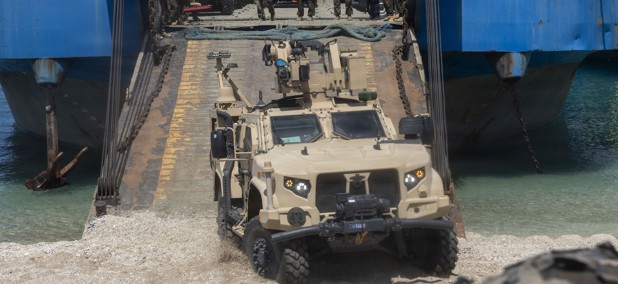
The timing connects directly to the Marine Corps' doctrine shift away from static command posts — a change already flagged in recent Fault Lines coverage. Autonomous ground vehicles that can relocate rapidly and conduct air defense operations reduce the signature and survivability constraints that made traditional CP architecture 'suicidal' against modern adversaries.
If this contract succeeds, expect follow-on investment in crewed-autonomous teaming for ground-based air defense, mirroring the Royal Navy's drone-command vessel architecture announced last week.
This signals the Marine Corps is moving autonomous ground platforms from concept into operational doctrine — specifically for air defense, where speed and dispersion are force multipliers against peer threats.
The $20M commitment forces a specific industrial partner to scale production on a timeline tied to force structure decisions: if the MLR and other littoral units are to field these systems by 2027-2028, manufacturing ramp must begin now. Watch whether this contract includes options for follow-on lots or whether it's a single-tranche test bed.
What is the unit cost per vehicle, and how many platforms does the $20M contract cover? Does the contract include options for production beyond this initial lot, and if so, what is the total potential value?
Fault Lines
Strategic intelligence, synthesized daily — with a public track record. Every call graded against what actually happened.