War on the Rocks: Japan's Cabinet Decision Timeline, Not Land-Access Laws, May Foreclose US Dispersal Before First Missile Salvo
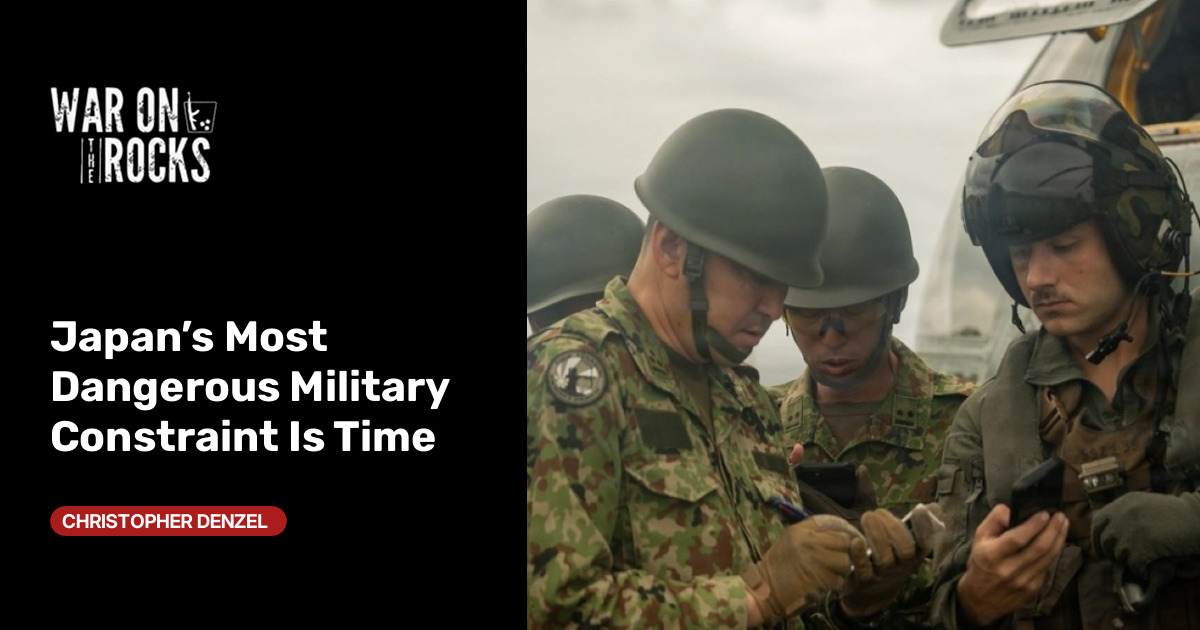
If the narrower legal reading has hardened into planning doctrine across both governments, the fix is not a new law but a bilateral administrative process that normalizes the broader interpretation through exercises before a crisis forces the question.
Denzel's framework — procedural flexibility developed bilaterally, political flexibility left to Tokyo — gives alliance managers a workable lane, but only if civilian institutions in both governments are brought into exercise design, which has historically been a military-to-military domain.
The risk is that the correct legal interpretation exists on paper but never gets rehearsed, leaving commanders in a crisis to discover the option for the first time under fire.
INDOPACOM's dispersal plans for US forces in Japan rest on an assumption that may be wrong in the direction that kills the option: if planners believe pre-attack land access requires cabinet authorization that only triggers post-attack, they will not attempt to disperse in the warning window.
Denzel's 2022 wargame found at least one earlier cabinet option that every other participant had missed — meaning the constraint may be procedural and solvable, not political and fixed. The distinction matters now because the PLA's November 6 unannounced Western Pacific exercise, already covered by Fault Lines, demonstrated the kind of rapid multi-theater deployment that would compress exactly this warning window.
Has the Japan-US bilateral planning community formally tested and documented the alternative cabinet interpretation Denzel's 2022 participant identified, and has it been incorporated into any standing contingency plan or exercise scenario since then?
Fault Lines
Strategic intelligence, synthesized daily — with a public track record. Every call graded against what actually happened.