L3Harris Wraith Shield Converts Handheld Radios Into Counter-Drone Jammers
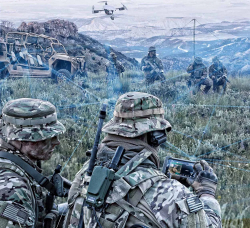
If Wraith Shield achieves adoption, it reshapes counter-UAS procurement logic for the primes. RTX's Coyote and Anduril's Barrage are kinetic solutions; L3Harris's approach is a denial layer that sits on existing infrastructure. That means a unit commander can now choose: spend $1.5M on a Coyote battery, or spend $200K on Wraith Shield licenses for 500 personnel and accept jamming as the primary effect.
The second option is cheaper and requires no new supply-chain qualification. For L3Harris, it's a margin play—software revenue on a hardware base they've already sold. For the primes selling dedicated counter-UAS platforms, it's margin compression.
Field units equipped with standard L3Harris radios gain organic counter-drone capability without a separate procurement cycle, which accelerates deployment timelines for personnel already carrying the platform.
This matters to CENTCOM and Pacific Fleet units rotating through high-drone-threat environments—the Hormuz escort rotation and South China Sea patrols—because it eliminates the logistics burden of fielding dedicated jamming equipment and training.
The mechanism is straightforward: if a unit's existing radio can scan, identify, and jam hostile drone signals with a software patch, then a $2M annual radio sustainment contract now covers counter-UAS as a secondary function, not a separate $400K-per-unit procurement line.
Watch whether the Army or Marine Corps formally adopts Wraith Shield into their standard radio refresh cycle by Q4 2026, which would signal confidence in the capability and lock L3Harris into a multi-year revenue stream across the force.
Does the Wraith Shield update degrade the radio's primary comms performance under jamming load, or is the antenna architecture clean enough to handle both functions simultaneously without interference?
Fault Lines
Strategic intelligence, synthesized daily — with a public track record. Every call graded against what actually happened.