General Atomics MQ-9B Clears First Flight with Saab LoyalEye AEW Radar Pod
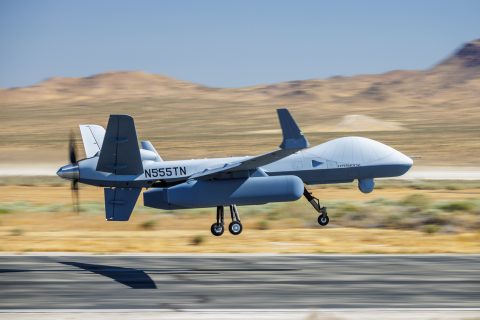
If this clears flight test and moves toward LRIP, Northrop Grumman's RQ-180 AEW roadmap loses urgency — the MQ-9B is cheaper, faster to field, and already in production. That shifts Northrop's capital toward other sensor payloads. Second: Saab now has a beachhead in the US remotely piloted aircraft ecosystem; if LoyalEye becomes standard on MQ-9B, Saab's radar licensing revenue scales with every export order.
Third, this accelerates the timeline for allied AEW procurement. Australia's Loyal Wingman program and the UK's Protector fleet will both evaluate MQ-9B AEW variants — meaning NATO's AEW-deficit problem (currently 8-10 E-3/E-7 sorties covering three theaters) becomes solvable without new large-platform buys.
This validates a capability gap that NATO and allied air forces have struggled to fill: persistent, long-endurance airborne early warning without tying up manned E-3 or E-7 assets.
For the US Air Force and allied air commanders, a production-ready MQ-9B AEW variant changes the calculus for forward deployment and sustained operations — particularly in the Indo-Pacific where INDOPACOM faces a 2,500-mile coverage problem and no spare E-7 sorties. General Atomics now holds a first-mover advantage in a market where the UK, Australia, and likely Japan will bid for AEW capability within 18-24 months.
The real constraint is production: MQ-9B builds run 50-60 units annually across all variants. If AEW demand captures even 20% of that (10-12 airframes per year), the company faces a production bottleneck by late 2027 that will force a choice between SkyGuardian exports and USAF inventory builds.
Has the US Air Force formally requested an AEW variant in its FY27 procurement plan, or is this still a technology demonstrator?
Fault Lines
Strategic intelligence, synthesized daily — with a public track record. Every call graded against what actually happened.