China Launches Twice as Many Submarines as Any Rival; Class Diversity Accelerates
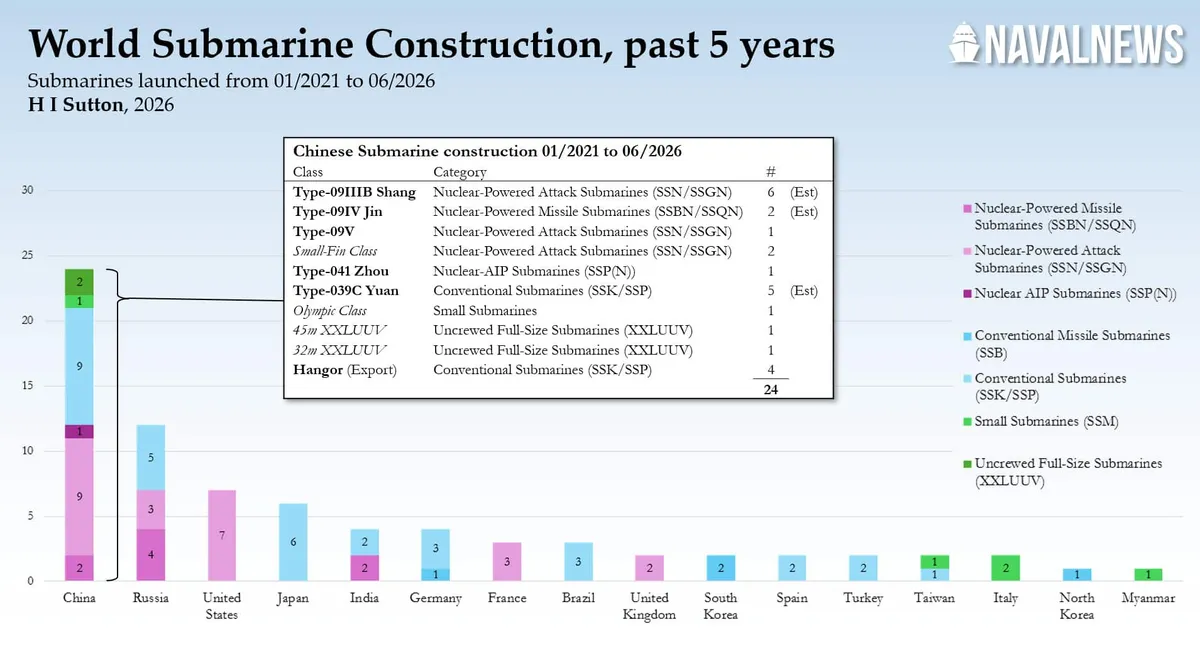
The undersea advantage compounds because submarine construction is not fungible with surface combatants or aircraft. If Virginia-class production stays at 1.2 hulls per year (current Congressional authorization), China gains roughly 1 net submarine per year in the Pacific—a 2% annual shift in the regional balance.
By 2032, that becomes a 20% imbalance, which translates to fewer patrol cycles per boat and reduced coverage of chokepoints (Taiwan Strait, Luzon Strait, Malacca).
The U.S.
Navy and its allies face a quantitative undersea deficit that cannot be closed through procurement alone. If China sustains current production rates—launching roughly 2-3 attack submarines annually plus ballistic-missile boats—the PLA Navy will field 70+ operational submarines by 2035, compared to roughly 50 across the entire U.S. Navy and all treaty allies combined.
This forces INDOPACOM and NAVSEA into a choice: accelerate Virginia-class and Columbia-class production at $2.6B and $9.3B per hull respectively, or accept strategic undersea inferiority in the Indo-Pacific for the next decade.
The metric that matters is not total hulls but deployable boats in contested waters; China's shorter design cycles and willingness to accept higher peacetime loss rates means effective operational submarines, not paper inventory.
Watch whether the FY27 defense authorization includes explicit submarine acceleration language tied to PLA production baselines—the absence of such language signals the Hill has accepted the deficit.
The article cites China's lead in launch rate but does not break down the operational readiness or deployment availability of these boats. Are these all frontline-capable platforms, or does the count include older units with limited range and sensor suites?
Fault Lines
Strategic intelligence, synthesized daily — with a public track record. Every call graded against what actually happened.