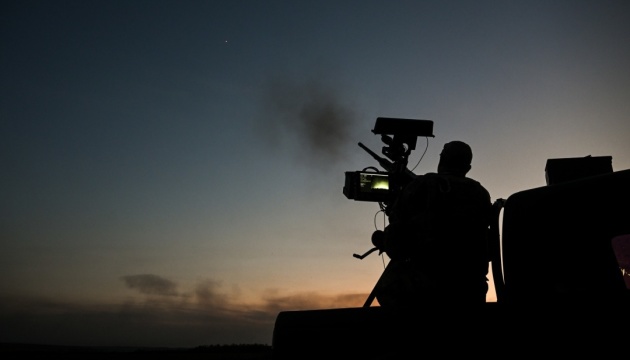
Ukraine Air Defense Intercepts 124 of 144 Russian Drones in 24-Hour Barrage
If Russia sustains 144-drone daily attacks, it exhausts loitering munition inventory faster than current production replaces it, forcing a reallocation toward cruise missiles and manned aircraft — both of which have higher pilot/crew risk and lower sortie rates. This would reduce Russian strike frequency by Q3, creating a tactical window for Ukrainian counteroffensive operations.
Simultaneously, the U.S. three-carrier deployment to the Middle East and lethal-force authorization against Iran means the Pentagon is now executing two simultaneous high-intensity air defense scenarios (Ukraine and Hormuz).
This is a single tactical snapshot, not a trend.
The 86% intercept rate is within Ukraine's demonstrated capability envelope over the past year — strong, but not anomalous. What matters is the *volume*: 144 drones in 24 hours suggests Russia is burning through inventory at a pace that matters for sustainment calculus.
If this rate holds weekly, Russia exhausts current drone production by Q3 2026, forcing a shift to cruise missiles (which drain air defense differently) or a reduction in sortie frequency. Watch whether this correlates with Russian losses elsewhere or signals a desperation push before a diplomatic window closes.
The timing — immediately after Trump's ceasefire extension attempt and Israel's breach of the Lebanon truce — suggests Moscow may be testing whether the U.S. is actually committed to containing escalation, or just managing it.
Are these 144 drones a one-off response to a specific Ukrainian target, or the start of a new sustained tempo? The source doesn't specify launch origin, target set, or whether this was concentrated or distributed across multiple fronts.
Fault Lines
Strategic intelligence, synthesized daily — with a public track record. Every call graded against what actually happened.