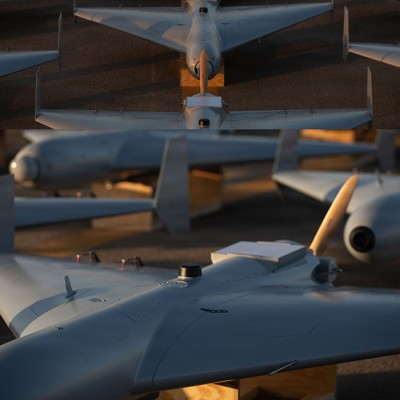
US Deploys Shahed Clone in Combat, Signaling Domestic Loitering Munition Capability
If LUCAS enters production at scale and lower cost than existing loitering munitions (Switchblade, Kamikaze), it will compress unit economics in the loitering munition market, forcing General Atomics, AeroVironment, and other autonomy vendors to either reduce prices or justify higher-cost platforms through sensor/guidance superiority.
This directly affects FY27-28 procurement budgets: programs like LMCO's Fury or AGM-179 HCSW may face competition from a government-owned design, shifting procurement leverage toward the Pentagon and away from traditional primes.
The LUCAS deployment demonstrates that the U.S. has achieved a reverse-engineered or indigenously developed equivalent to a proven, low-cost autonomous system.
This matters for two reasons: First, it suggests the Pentagon has closed a capability gap in cheap, expendable strike platforms — historically a vulnerability against peer adversaries with large drone arsenals.
Second, the decision to field a Shahed-derived design rather than an original architecture implies either time pressure (faster to copy than innovate) or cost constraints (reverse-engineering cheaper than new development). This forces a reassessment of U.S. loitering munition procurement strategy: if LUCAS proves effective, it may accelerate orders and pull resources from higher-cost platforms.
The absence of details on production scale, unit cost, and operational employment doctrine leaves the strategic significance unclear — a single combat use could be a proof-of-concept or the leading edge of a new strike doctrine.
The article does not disclose LUCAS unit cost, production capacity, the operational theater or target set, damage assessment, or whether this represents a one-off test or the beginning of serial deployment.
Fault Lines
Strategic intelligence, synthesized daily — with a public track record. Every call graded against what actually happened.