Army Tests Airburst Shells on Apache to Counter Drone Swarms; Ukraine Lessons Drive Retrofit
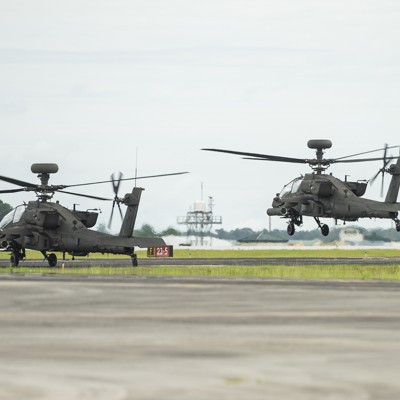
The airburst retrofit addresses a specific vulnerability exposed in the Iran war and Lebanon operations—Apache crews cannot effectively engage drone swarms without abandoning hover positions or expending expensive Hellfire rounds on targets worth $10K-50K.
If this solution proves effective and gets fielded across the fleet, it reduces the operational cost of maintaining air superiority in contested airspace, which directly affects force rotation rates and maintenance schedules for units supporting Middle East operations.
This is tactical adaptation, not a capability overhaul.
Apaches already fly in contested airspace; adding airburst rounds makes them marginally more survivable against drone threats but doesn't solve the underlying problem—rotary-wing platforms are inherently vulnerable to coordinated swarms. The real signal is that the Army is pulling lessons from Ukraine and Iran fast enough to prototype fixes within months.
If this works and gets fielded by FY27, expect similar rapid-cycle retrofits across the attack helicopter fleet. If it doesn't—if integration is messy or the rounds prove ineffective—the Army's gap in counter-UAS will become a doctrine problem, not just a procurement one. Watch whether this leads to a formal requirement or stays a field-expedient hack.
Did the Army test this against actual drone profiles from Hezbollah or Iranian proxies, or only against notional small-UAS threat models? The relevance hinges on whether the test conditions match what Apaches actually face in the Middle East right now.
Fault Lines
Strategic intelligence, synthesized daily — with a public track record. Every call graded against what actually happened.