Army tests munitions strategy for high-volume target engagement in NATO exercise
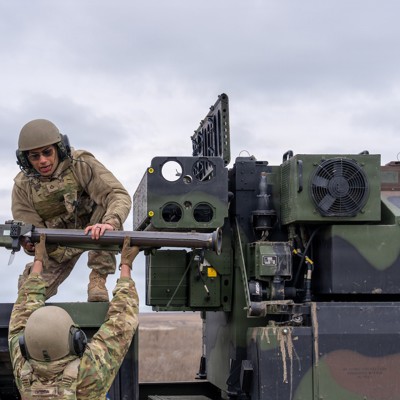
This is primarily a Power Projection story with a secondary Market Forces angle. The exercise tests whether U.S.-NATO forces can sustain offensive operations against defended targets — a direct response to Russian and Chinese integrated air defense systems.
The munitions and decoy drone requirements create procurement signals for RTX (missiles/EW), Northrop (autonomous systems), and Raytheon (air defense countermeasures), but only if the exercise translates to formal requirements. Limited cross-pillar relevance unless the exercise informs NATO interoperability standards or alliance burden-sharing on munitions production.
This signals a shift in Army targeting doctrine toward attrition-based engagement at scale, likely driven by peer-competitor air defense proliferation (Russia, China).
The specific requirement for EW-hardened munitions and decoy drones creates procurement pressure on precision munitions suppliers and autonomous systems vendors. If the 1,500-target-per-day rate becomes a formal requirement, it will drive volume commitments and supplier capacity planning — but the article does not specify whether this is an aspirational exercise outcome or a binding operational requirement.
The gap between exercise demonstration and fielded capability determines whether this translates to near-term production orders.
The article does not clarify whether the 1,500-target rate is a doctrinal requirement, a capability goal, or an exercise-specific scenario; nor does it specify which munition types or platforms would execute this mission, making it impossible to assess which primes or suppliers face actual demand si...
Fault Lines
Strategic intelligence, synthesized daily — with a public track record. Every call graded against what actually happened.