Space Force Recruitment Surge Masks Civilian Exodus as $1.5T Budget Looms
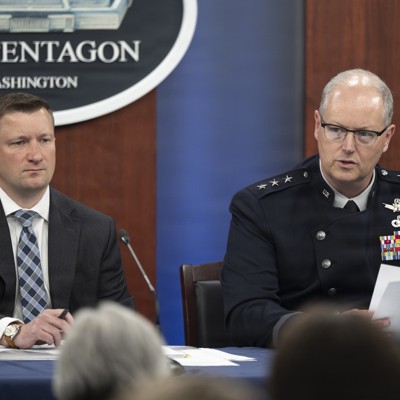
The Space Force's workforce crunch directly constrains the execution velocity of the Hormuz blockade enforcement architecture that Trump has committed to accelerate.
Hernandez-Baquero and Mason's appointments suggest the Pentagon intends to outsource acquisition risk to industry partners — a strategy that works only if contractors can deliver satellites, ISR payloads, and comms terminals faster than civil service can certify them.
If Space Force can't keep pace with budget increases, the multinational Hormuz enforcement coalition (UK, France, 30+ nations) will face delays in space-based ISR and targeting layers, pushing timeline risk into 2027.
The Space Force faces a genuine workforce problem masquerading as a budget problem.
Civilian acquisition talent doesn't rebuild in quarters — it takes 18-24 months to onboard and certify engineers and program managers. If the departures were significant enough to trigger emergency hiring, the service is already behind on FY27 execution.
The appointment of industry executives to acquisition posts signals the Pentagon is betting on contractor-led program acceleration rather than organic civil service capacity. This works only if those executives can compress procurement timelines — which depends on whether Congress actually appropriates the full $1.5T and whether space primes (SpaceX, Northrop, ULA) have the production capacity to absorb it.
The real risk: budget increases without matching workforce depth create cost overruns and schedule slips on the very programs (NGSA, proliferated LEO constellation, next-gen comms) that were supposed to accelerate.
How many civilian billets has the Space Force actually lost in the past 18 months, and in which disciplines (systems engineers, program managers, cost analysts)?
Fault Lines
Strategic intelligence, synthesized daily — with a public track record. Every call graded against what actually happened.