Air Force Plans to Retire 7 E-11 BACN Aircraft; DAF Battle Network Replacement Timelines Unclear
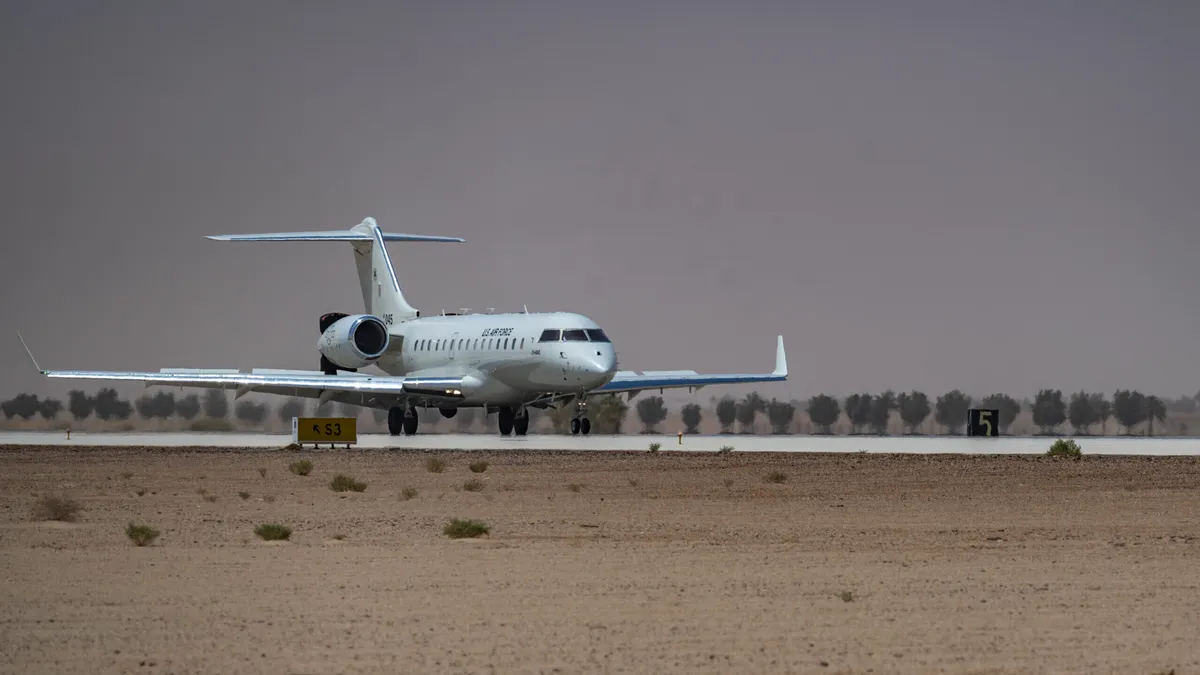
E-11 retirement directly impacts power projection in two active theaters: the Iran blockade (requiring persistent ISR relay for naval strike coordination) and the Lebanon escalation (requiring real-time targeting data fusion for close-air-support missions).
If the Battle Network is not ready on schedule, the Air Force loses the ability to relay targeting data from airborne sensors to distributed strike platforms, forcing a reversion to ground-based relay nodes or degraded targeting cycles.
This cascades into procurement: if the Battle Network slips, the Air Force will face pressure to extend E-11 service life, triggering retrofit and sustainment contracts that compete with new-start funding in a constrained budget environment.
The E-11 is the sole airborne relay platform for joint fires coordination across the Middle East and Indo-Pacific theaters.
Retiring it without a fielded replacement creates a gap in command-and-control coverage during an active multi-theater conflict. The Air Force is currently operating under a 60-day War Powers constraint in the Iran theater (deadline passed April 30) and supporting Israeli operations in Lebanon — both scenarios requiring real-time targeting data relay.
If the Battle Network is not operationally ready before E-11 retirement, tactical-level targeting latency increases measurably, degrading time-sensitive strike effectiveness. The spokesperson's statement offers no acquisition timeline, production readiness date, or interim bridging strategy, suggesting the retirement decision may have outpaced the replacement program's maturity.
What is the actual operational availability date for the DAF Battle Network, and has the Air Force conducted a gap analysis quantifying the command-and-control vulnerability between E-11 retirement and Battle Network IOC?
Fault Lines
Strategic intelligence, synthesized daily — with a public track record. Every call graded against what actually happened.