CJCS Claims Global Interception Authority on Iran-Linked Vessels; Extends Blockade Beyond Hormuz
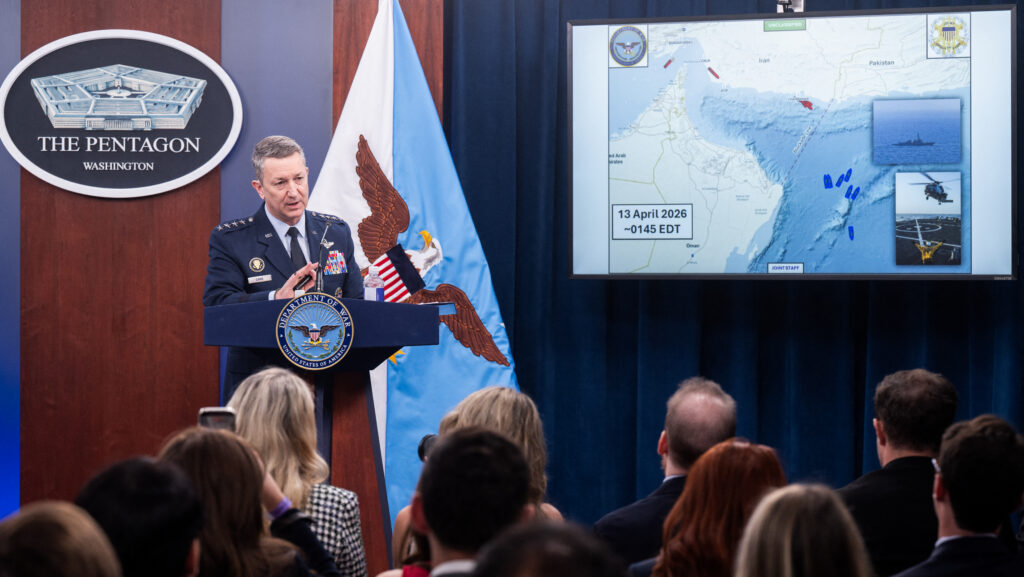
Caine's global interdiction claim closes the enforcement gap exposed by the second supertanker breach (April 16): if the U.S. Navy can interdict Iran-linked cargo worldwide, not just at Hormuz, the blockade's credibility shifts from geographic bottleneck to absolute denial.
This forces third-party flag states and insurers into active compliance or active defection — either way, it converts shipping logistics into a binary choice (Iran or U.S.), which accelerates the secondary boycott and raises retaliation risk if China or Russia flag vessels to circumvent U.S. authority.
Caine's statement transforms the Iran blockade from a regional choke point (Hormuz) into a claim of global interdiction authority.
This creates immediate friction with maritime law and third-party flag states: any ship flagged to Panama, Marshall Islands, or Singapore carrying Iranian cargo becomes a U.S. target, forcing those flag registries to either enforce their own sanctions or accept U.S. boarding/seizure.
The practical consequence is that shipping insurers and freight forwarders will treat any Iran-linked cargo as globally at-risk, not just in the Gulf — this accelerates the secondary boycott effect already visible in the second supertanker breach (April 16 signal).
However, the statement lacks operational detail: it does not specify rules of engagement, geographic limits, or coordination with allies, creating ambiguity about whether this applies to allied vessels or only flagged Iranian ships.
If enforced uniformly, this could trigger allied pushback (EU, Japan, South Korea all have shipping in the Indian Ocean and Pacific); if enforced selectively, it signals U.S. willingness to use maritime interdiction as a geopolitical lever independent of international law.
The statement does not clarify whether the global interdiction applies to all vessels carrying Iranian cargo or only Iranian-flagged ships, nor does it specify rules of engagement, boarding authority, or coordination with allied navies operating in the Pacific and Indian Ocean.
Fault Lines
Strategic intelligence, synthesized daily — with a public track record. Every call graded against what actually happened.