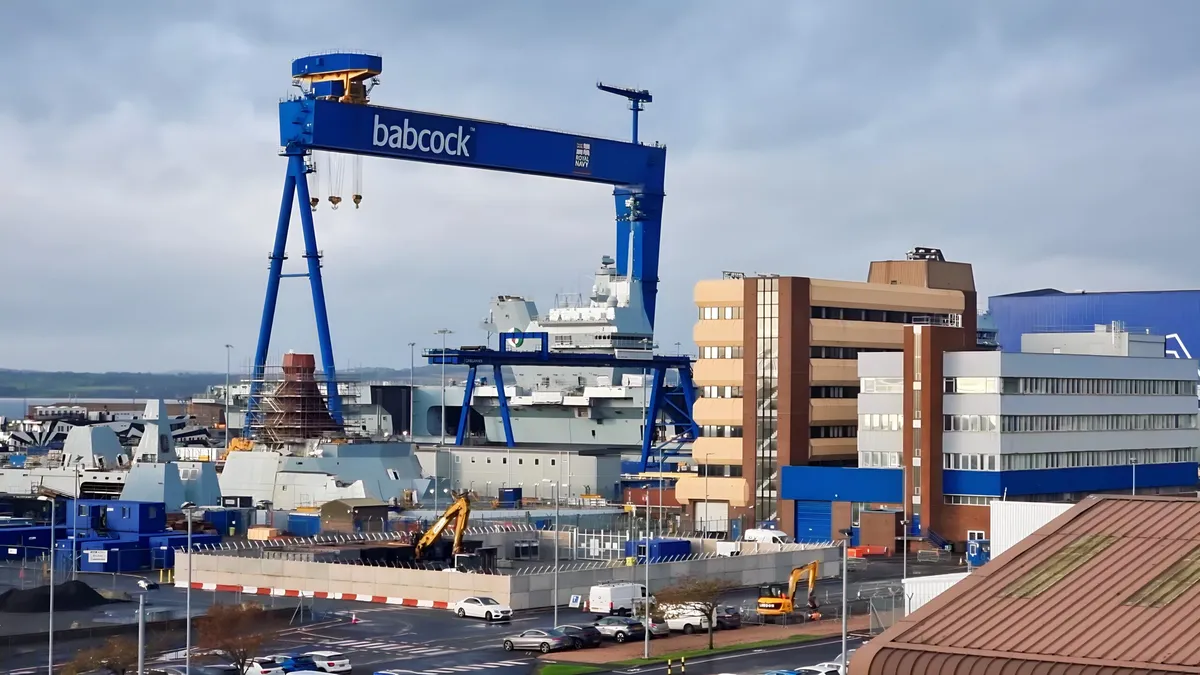
Babcock Warns Rosyth Frigate Line Faces Workforce Collapse Without Post-Type 31 Contract
UK frigate production collapse directly compresses allied surface combatant inventory at the moment NATO is operationalizing Article 42(7) and the US is deploying three carriers to the Middle East.
The Royal Navy's 13 Type 45 destroyers and future Type 31 fleet are already committed to EUFOR and CENTCOM rotations — losing production capacity means no surge builds for contingency operations (Taiwan scenario, NATO reinforcement, or sustained Middle East presence).
This forces either extended deployment cycles (crew burnout, maintenance deferral) or earlier retirement of older hulls (HMS Queen Elizabeth class carrier support shrinks). Germany's India defense pact (yesterday's signal) explicitly includes submarine production — the UK's Type 26 program is already years behind schedule.
This is a capacity warning, not a capability crisis — yet.
Babcock is signaling that the UK's only active frigate yard will go dark unless Westminster commits to a successor program within the next 18-24 months (Type 31 production ends around 2028-2029). The immediate issue: industrial base continuity. If Rosyth shuts down, restarting a frigate line costs roughly £1-2B in tooling and workforce rehire — money the MOD doesn't have.
The strategic issue is sharper: the UK is simultaneously expanding NATO commitments (Article 42(7) activation per yesterday's signal), deploying to the Indo-Pacific, and facing the most contested European security environment since 2003. A frigate yard closure during this window means the Royal Navy's surface combatant fleet becomes a fixed inventory with no surge capacity.
Export orders (Australia, potentially others) buy time but don't solve the underlying problem — a domestic production line needs domestic demand to justify tooling investment. Babcock is essentially telling the MOD: pick a follow-on program now or accept that Britain's frigate-building capability dies.
Is the MOD considering a Type 32 design, or is this a gap that will be filled by export variants only? And what is the realistic timeline for a successor program — are we talking 2027 contract placement, or is this a 2030+ decision that leaves Rosyth dark for 2-3 years?
Fault Lines
Strategic intelligence, synthesized daily — with a public track record. Every call graded against what actually happened.