Ukraine's 25,000 Combat Robots Face Signal Loss in Contested Terrain; Connectivity, Not Hardware, Limits Deployment
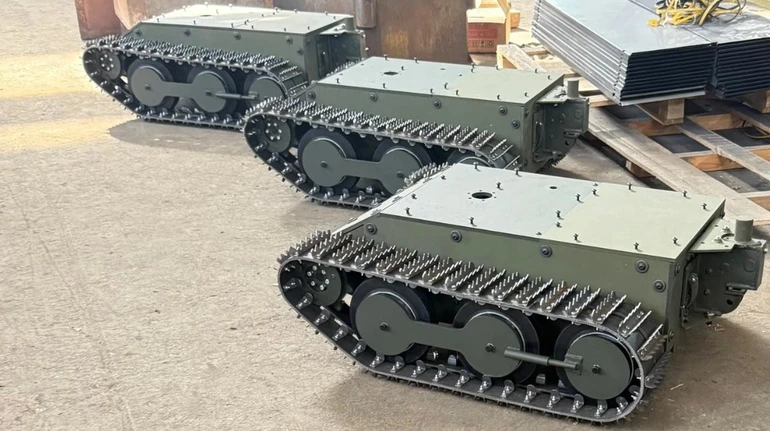
Ukraine is discovering what the U.S. learned in Iraq and Afghanistan: unmanned systems are only as effective as their command link. If Russia can degrade signal integrity in a sector, Ukraine's robots either operate under pre-programmed logic (reducing responsiveness and increasing civilian risk) or go dark.
This forces a procurement reckoning for NATO: the next generation of autonomous systems cannot assume a benign RF environment. The implication cascades into industrial base planning — if NATO allies must now field EW-hardened comms for every autonomous platform, that's a new production line, new supply chain, and new cost-per-unit that wasn't in the FYDP.
This surfaces a hard constraint on unmanned system deployment that no amount of procurement can solve: if the communication architecture fails, the platform becomes a liability.
For Ukraine's General Staff, this means the 25,000-unit inventory cannot be treated as force multipliers in contested airspace where Russian EW (electronic warfare) degrades signal integrity.
The operational consequence is immediate: robots operating beyond line-of-sight in areas of active jamming will either fail to receive commands or execute last-known instructions with no human override — turning them into targets or fratricide risks.
The smart operator must now choose between deploying robots only in areas with hardened comms (reducing their tactical utility) or accepting a loss rate that could spike if Russia escalates EW operations.
For US and allied procurement teams watching Ukraine's lessons-learned, this is a 2026 test case: if Ukraine's robots are failing on signal loss despite being domestically produced and networked, what happens when NATO deploys autonomous systems across a 500-mile front against a peer adversary with dedicated EW battalions?
The implication is that force structure planning for AUKUS and NATO must budget for comms infrastructure and EW hardening at parity with platform procurement — a cost that rarely surfaces in contract awards.
What percentage of the 25,000 robots are currently non-operational due to signal loss? Does the article distinguish between robots lost to EW jamming versus those experiencing intermittent connectivity? Are there specific geographic areas (e.g., Donbas sectors) where signal loss is endemic?
Fault Lines
Strategic intelligence, synthesized daily — with a public track record. Every call graded against what actually happened.