France Deploys €500M in Public Funding to Domesticate Quantum Computing via Alice & Bob Cat-Qubit System
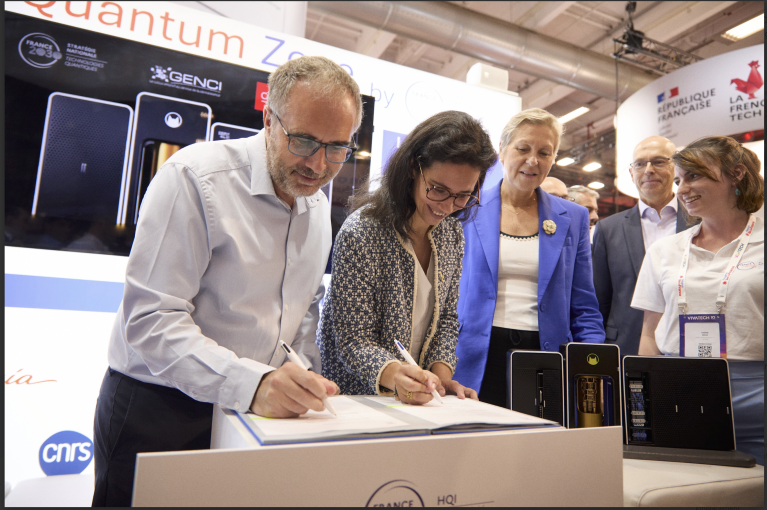
This is industrial policy dressed as procurement. France is not buying quantum computing capacity — it's buying a domestic quantum ecosystem.
If Alice & Bob's cat-qubit architecture proves competitive on error rates or coherence time, the HQI model (state funding + domestic vendor lock-in) becomes a template for Germany and Italy, fragmenting EU quantum development and forcing Brussels to choose between standardizing on one architecture or funding three parallel paths.
The harder constraint: cat-qubits are still in the 18-50 qubit range, while IBM and Google have crossed 100+ qubits.
France is betting state capital on a quantum architecture (cat-qubits) that competes with superconducting and ion-trap approaches favored by the US and China, creating a three-way split in quantum development pathways.
This matters because quantum computing roadmaps determine which companies, supply chains, and technical standards dominate the next decade — and France is explicitly choosing a domestic vendor and a non-mainstream architecture rather than waiting for US or Chinese systems to mature.
GENCI's procurement signals that European quantum strategy is moving from research grants to operational deployment, which forces EU allies (Germany, UK, Italy) to choose whether to follow France's cat-qubit bet or hedge with alternative approaches.
The timeline is immediate: if the 18-qubit system delivers performance claims, France will likely request EU co-funding for a larger deployment — turning a national procurement into an alliance standard-setting moment by 2027-2028.
What performance benchmarks did Alice & Bob commit to, and what happens to GENCI's roadmap if the cat-qubit system underperforms superconducting systems from IBM or IonQ at equivalent qubit counts?
Fault Lines
Strategic intelligence, synthesized daily — with a public track record. Every call graded against what actually happened.