Navy Kills MASC Program, Launches MUSV Marketplace to Accelerate Unmanned Surface Vessel Delivery to FY27
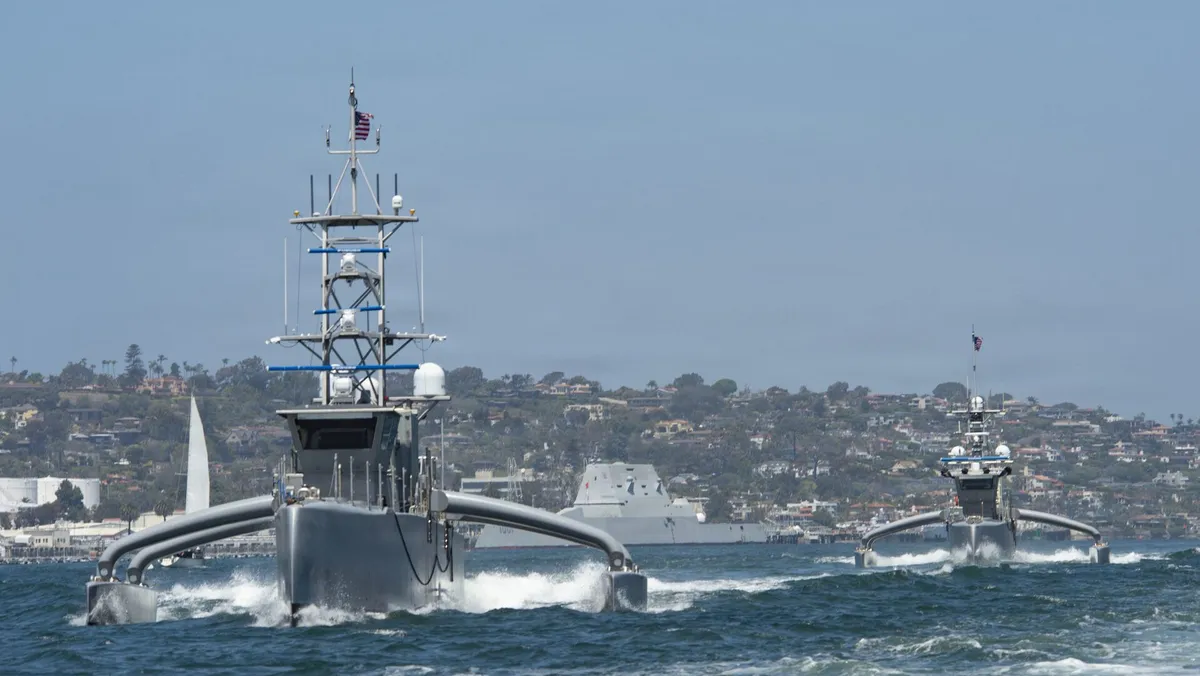
The MASC cancellation compresses the Navy's unmanned surface combat timeline by 3-5 years, which directly affects force structure assumptions in the Indo-Pacific contingency plan. If MUSVs enter service by FY27, they alter the calculus for distributed naval operations against China — more platforms, lower per-unit cost, but reduced individual capability.
Conversely, if the marketplace approach yields immature autonomy or integration failures, the Navy loses a critical force-multiplier in a high-intensity Taiwan scenario.
The MASC cancellation removes a 5+ year developmental timeline and signals the Navy is pivoting from custom-built autonomous combat systems to off-the-shelf or near-production platforms.
This accelerates MUSV fielding but narrows the technical specification window — vendors who've invested in MASC-aligned designs (Ranger, Ranger II concepts) face redesign costs or exclusion, while companies with existing surface vessel production capacity (Austal, Bollinger, Vigor) gain competitive advantage.
The FY27 delivery target is aggressive and depends on whether marketplace vendors can meet combat-grade autonomy requirements without additional integration risk. Success hinges on whether Navy accepts lower customization in exchange for speed.
The article does not specify which vendors are pre-qualified for the marketplace, what the minimum technical requirements are for MUSV autonomy and weapons integration, or whether the FY27 target applies to prototype delivery or operational deployment.
Fault Lines
Strategic intelligence, synthesized daily — with a public track record. Every call graded against what actually happened.