Ukraine Air Defense Downs 602 Drones, 40 Missiles in June 1 Assault; Intercept Rate Holds Amid Sustained Russian Campaign
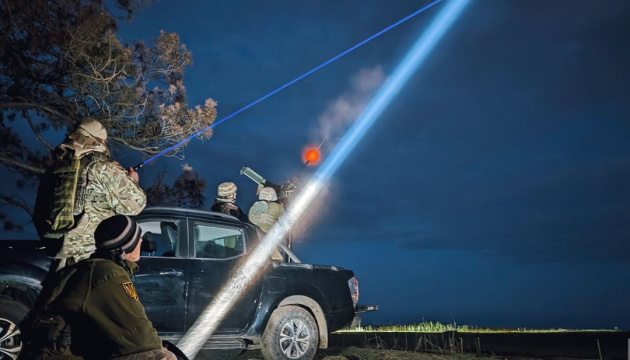
If Ukraine is intercepting 94% of 642 inbound munitions in a single night, Russian strike economics are deteriorating. A Kalibr costs ~$1.5M; a Shahed costs ~$20K. If Russia is cycling through inventory at this rate across three campaigns in five days, sustained attrition could force a shift toward cheaper, lower-accuracy systems—which pushes the war toward attritional grinding rather than precision targeting.
That shift favors Ukrainian air defense (easier to intercept volume) but favors Russian manpower reserves (attrition war is what Russia has). The second-order effect: if Russia accelerates to overcome saturation, munitions production becomes the hard constraint.
Ukraine's sustained intercept rate—602 drones and 40 missiles in a single night—signals that air defense capacity, not attrition, is now the binding constraint on Russian strike effectiveness.
This matters directly to INDOPACOM and European command planners: if Ukraine can absorb 642 munitions and keep operational continuity, Russian mass-saturation tactics are failing to achieve degradation.
The timeline is critical—Ukraine has now absorbed three major Russian air campaigns in five days (May 29-June 2) without reported loss of critical infrastructure, suggesting either Russian targeting has shifted away from strategic nodes or Ukrainian passive defense (hardening, dispersal, sheltering) is working at scale.
Watch whether Russian strike frequency increases to compensate for lower per-sortie effectiveness, and whether that acceleration forces NATO to accelerate air defense shipments (Patriot, IRIS-T, Gepard) on a timeline not yet in the FYDP.
What is the actual composition of the 602 drones—Shahed-131/136, FPV loitering munitions, or reconnaissance drones? The intercept rate varies wildly by platform type. Also: are these 40 missiles cruise missiles (Kalibr, X-101) or ballistic systems (Iskander, S-300)?
Fault Lines
Strategic intelligence, synthesized daily — with a public track record. Every call graded against what actually happened.