US Clears $2.5B MH-60R Sale to New Zealand; Deepens AUKUS Naval Interoperability
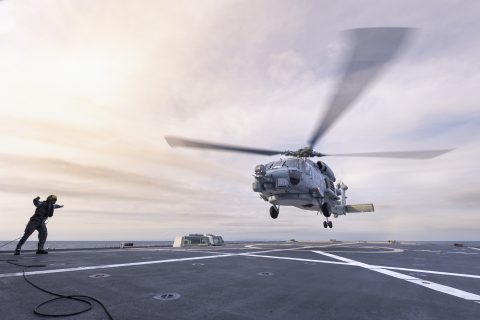
The sale is incremental interoperability infrastructure, not a capability shock. But it signals that AUKUS partners are moving past doctrinal alignment into hardware standardization — a 15-year trend accelerating.
If New Zealand commits to the full five-aircraft buy, Sikorsky's rotary-wing production line faces a choice: expand Stratford capacity (capital-intensive, 18-24 month lead time) or extend US Navy MH-60R delivery schedules. Given that the Air Force production bottleneck already blocks 108 aircraft buys in FY27, helicopter production is next on the constraint list.
The real test is whether Australia's planned MH-60R refresh orders (number TBD) will collide with New Zealand's intake schedule.
New Zealand gains a platform that directly integrates with US and Australian maritime operations in the Indo-Pacific, closing a capability gap during a period when INDOPACOM is stretched across multiple contingencies — Iran escalation in the Arabian Sea, Taiwan Strait surveillance, and Hormuz transit security.
The MH-60R's sensor suite (dipping sonar, radar, ESM) makes it interoperable with US Navy and RAAF rotary-wing architecture, reducing coordination friction in coordinated ASW operations.
Watch for New Zealand's formal purchase order timeline — if it slips past late 2026, production delays at Sikorsky's Stratford facility (already constrained by US Navy LRIP demand) will cascade into delivery schedules for all allied customers.
Does the $2.5B figure include lifecycle support costs through 2035, or is it platform-only? The article doesn't specify, and that distinction affects whether this is a near-term or long-term budget commitment for Wellington.
Fault Lines
Strategic intelligence, synthesized daily — with a public track record. Every call graded against what actually happened.