Air Force Mounts AIM-120s on CCA Prototype, Advancing Armed Autonomy Testing
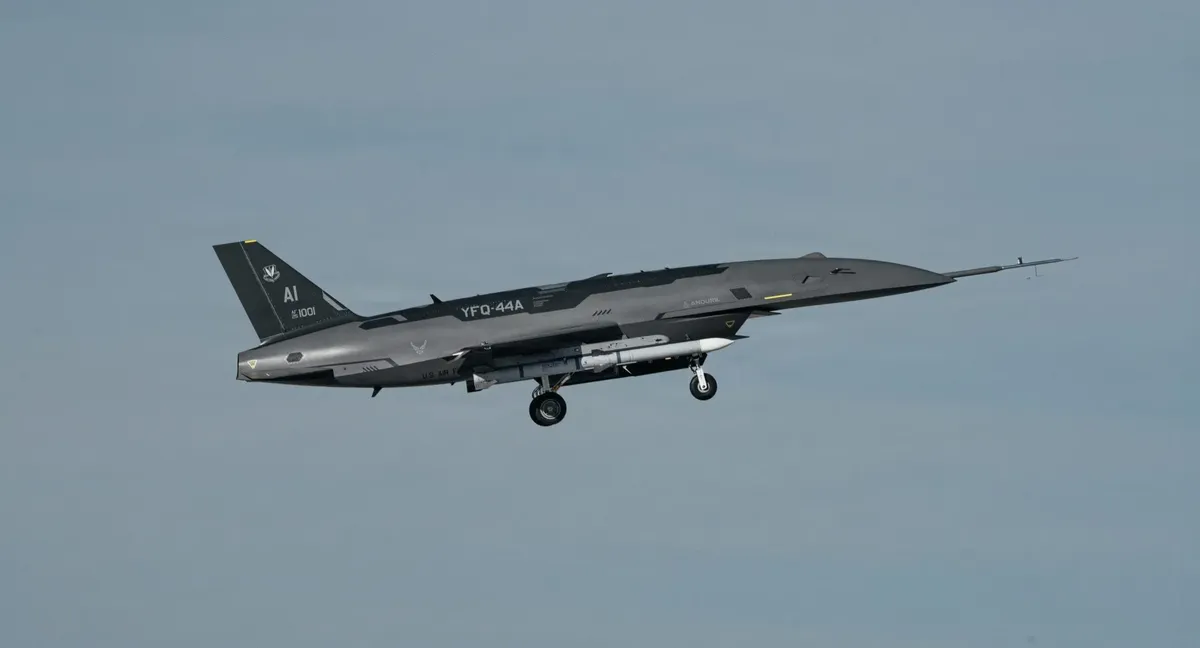
Armed CCA testing accelerates the retirement timeline for legacy air-defense platforms (F-15C, older F-16 variants) by demonstrating a lower-cost autonomous alternative, which reallocates procurement dollars from airframe production to sensor/networking infrastructure — specifically Link 16 upgrades and AI-enabled target-handoff systems.
This forces RTX and Northrop to compete on integration cost, not platform cost, reshaping their margin profiles on next-gen fire-control systems.
This escalates CCA from a concept-demonstrator to a weapons-integration testbed, compressing the path from prototype to operational employment.
The choice of AIM-120 (a beyond-visual-range missile requiring target handoff from manned or autonomous sensors) signals Air Force intent to field CCAs as autonomous or semi-autonomous interceptors, not just ISR platforms.
This forces three decisions: (1) Anduril's manufacturing roadmap — captive-carry tests precede full integration, and integration timelines determine when CCAs compete with manned F-15EX/F-16 for air-defense budgets; (2) Autonomous engagement rules — the Air Force must finalize human-in-the-loop doctrine before full-rate production, a regulatory gate that has delayed other autonomy programs; (3) Allied interoperability — NATO and Indo-Pacific partners will demand AIM-120 integration standards before co-flying CCAs, creating export-control friction if the platform matures faster than doctrine.
The test itself is incremental; the cascade into procurement and doctrine is not.
The article does not specify whether captive-carry is a precursor to live-fire testing, the timeline for full weapons integration, or whether the Air Force has issued any formal requirements document (like an Operational Requirements Document) that would commit budget to CCA production.
Fault Lines
Strategic intelligence, synthesized daily — with a public track record. Every call graded against what actually happened.