Air Force Awards Kongsberg $240.9M for Joint Strike Missile Lot Two Production
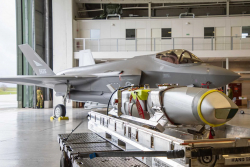
Kongsberg's production line now anchors F-35 standoff strike across four allied air forces simultaneously. If production ramps to more than 300 units annually, the company faces capacity constraints at its Kongsberg, Norway facility—a bottleneck that will surface in FY27 procurement planning when INDOPACOM and European air commands request accelerated delivery schedules.
The AGM-184 is the only air-launched standoff weapon the F-35 can carry without external carriage (internal bay integration), making it the default choice for contested airspace. Raytheon's Tomahawk (sea-launched) and Lockheed's JASSM (external carriage) are now secondary options for F-35 employment, a shift that reorders how Air Force and Navy planners allocate standoff strike across platforms.
F-35 operators across the U.S.
Air Force, Navy, and allied air forces (UK, Australia, Canada, Poland, Japan, South Korea) now have a confirmed production pathway for a standoff anti-ship and land-attack weapon that extends engagement range beyond legacy Maverick and JDAM integration.
Kongsberg's Lot Two award validates the AGM-184 as the primary F-35 standoff missile in the NATO and Indo-Pacific inventories, locking in production cadence through at least 2028.
The $240.9M commitment signals DoD confidence in the system's performance, but the contract size (Lot Two only) leaves the critical question open: what is the annual production rate, and does it match the 1,800+ anti-ship missile target Taiwan is building by 2029, or the munitions consumption rates observed in Ukraine and the Red Sea?
What is the unit price per missile in Lot Two, and what is the planned annual production rate? The contract value alone doesn't reveal whether this is 100 missiles or 1,000 missiles, which determines whether Kongsberg can sustain allied demand if Taiwan Strait contingency operations begin before 202...
Fault Lines
Strategic intelligence, synthesized daily — with a public track record. Every call graded against what actually happened.