Hormuz Blockade Reverses India's Russian Oil Retreat; Moscow Gains $2.8B Revenue Windfall
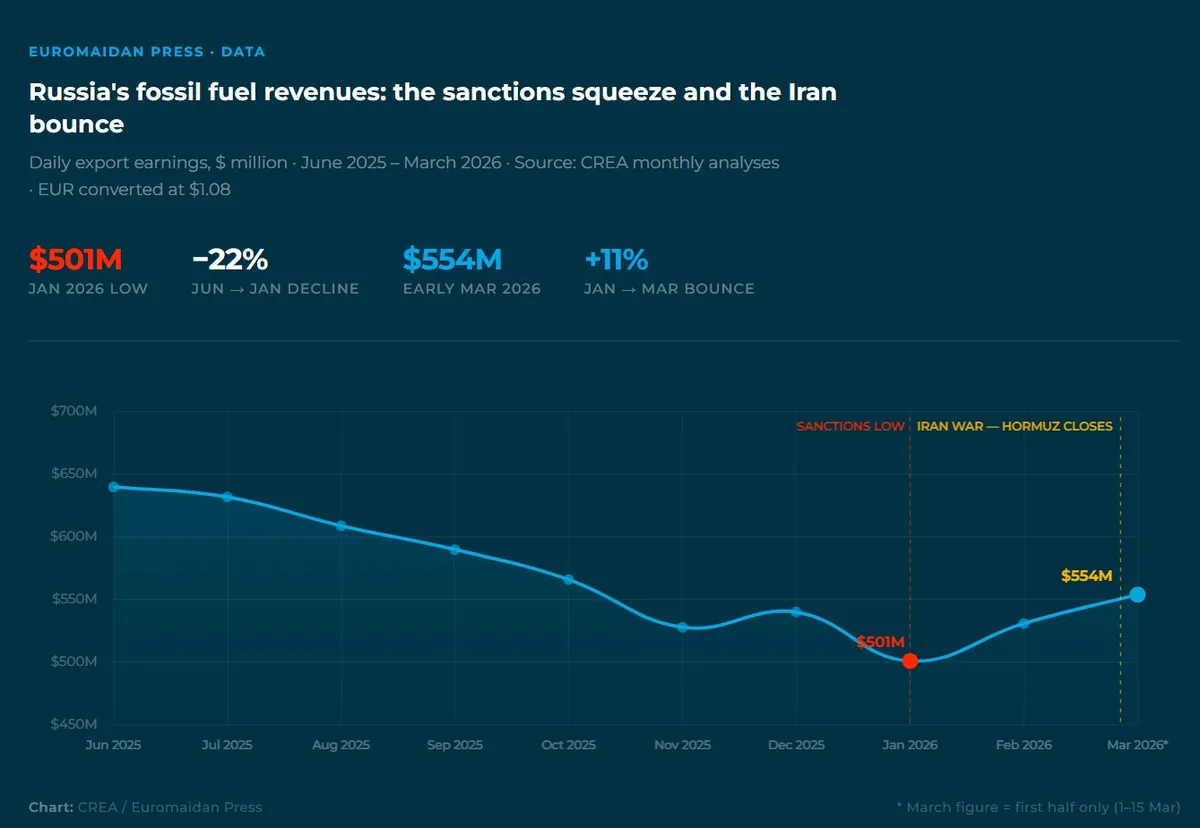
The Hormuz blockade converts energy sanctions into a conflict duration variable. Every day Iran maintains strait closure extends Russia's revenue windfall and reduces Western leverage over Moscow's posture toward Ukraine or NATO.
If India's oil purchases lock in at elevated volumes through Q2 2026, Gazprom and Rosneft will have less pressure to negotiate export pricing concessions, weakening EU energy leverage in any Ukraine settlement talks.
Conversely, if the multinational escort force (seven-nation statement, March 19 signal) successfully reopens the strait to normal traffic, Indian demand collapses back to pre-blockade levels and Russia loses the windfall—making strait control the hinge between energy sanctions effectiveness and their failure.
The Hormuz blockade—a direct consequence of the US-Israel-Iran conflict already underway—has inverted a key sanctions objective.
India's retreat from Russian oil was a centerpiece of Western energy isolation strategy; its forced return due to Persian Gulf supply collapse means sanctions enforcement now depends entirely on maintaining the blockade. If Iran opens selective transit (per March 20 signal on vetting systems), Russian revenues could stabilize at elevated levels indefinitely.
This creates a perverse incentive: the longer the conflict continues, the more durable Russia's sanctions evasion becomes. For defense planners, this means the Iran war is now financing a secondary beneficiary—Moscow—and that revenue stream is hostage to Hormuz control, not diplomatic off-ramps.
The article does not specify which Russian crude grades India is purchasing, at what price premiums relative to WTI, or whether this is a temporary spike or a structural reallocation. It also does not quantify the 14% increase in absolute terms (is this $2.8B or $28B additional revenue?
Fault Lines
Strategic intelligence, synthesized daily — with a public track record. Every call graded against what actually happened.