Belgium Offers All F-16s to Ukraine Post-F-35 Transition; NATO Ally Signals Sustained Commitment
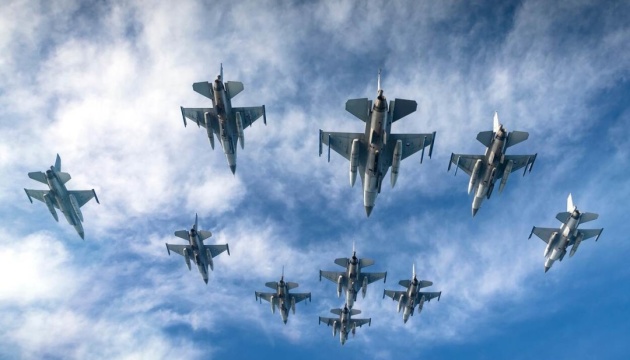
If Belgium commits all F-16s, it removes roughly 30-40 airframes from NATO's active inventory — a non-trivial erosion of allied capacity. More importantly, it establishes a precedent: other NATO operators may follow, which would mean the F-16 supply line to Ukraine closes when F-35 IOC timelines align.
This creates a window of 18-36 months where Ukrainian fighter strength depends entirely on attrition management and allied pilot training capacity, not on new airframe delivery. The constraint becomes industrial, not political.
This signals a hard constraint on NATO's ability to sustain F-16 supply to Ukraine: allied inventories are finite, and the transition timeline to F-35s now becomes the binding lever on Ukrainian fighter availability.
Francken's statement suggests Belgium will exhaust its F-16 inventory by the time F-35 deliveries mature — likely 2027-2029 depending on production and integration schedules.
Watch whether other NATO operators (Poland, Romania, Denmark, Netherlands) make similar commitments, which would effectively cap total F-16 flow to Ukraine and force the alliance to accelerate fourth-generation fighter retirements or accept a near-term air superiority gap.
What is Belgium's actual F-16 inventory count, and what is the delivery timeline for its F-35 tranches? Without these numbers, it's impossible to calculate when the transition occurs and whether other allies face the same constraint.
Fault Lines
Strategic intelligence, synthesized daily — with a public track record. Every call graded against what actually happened.