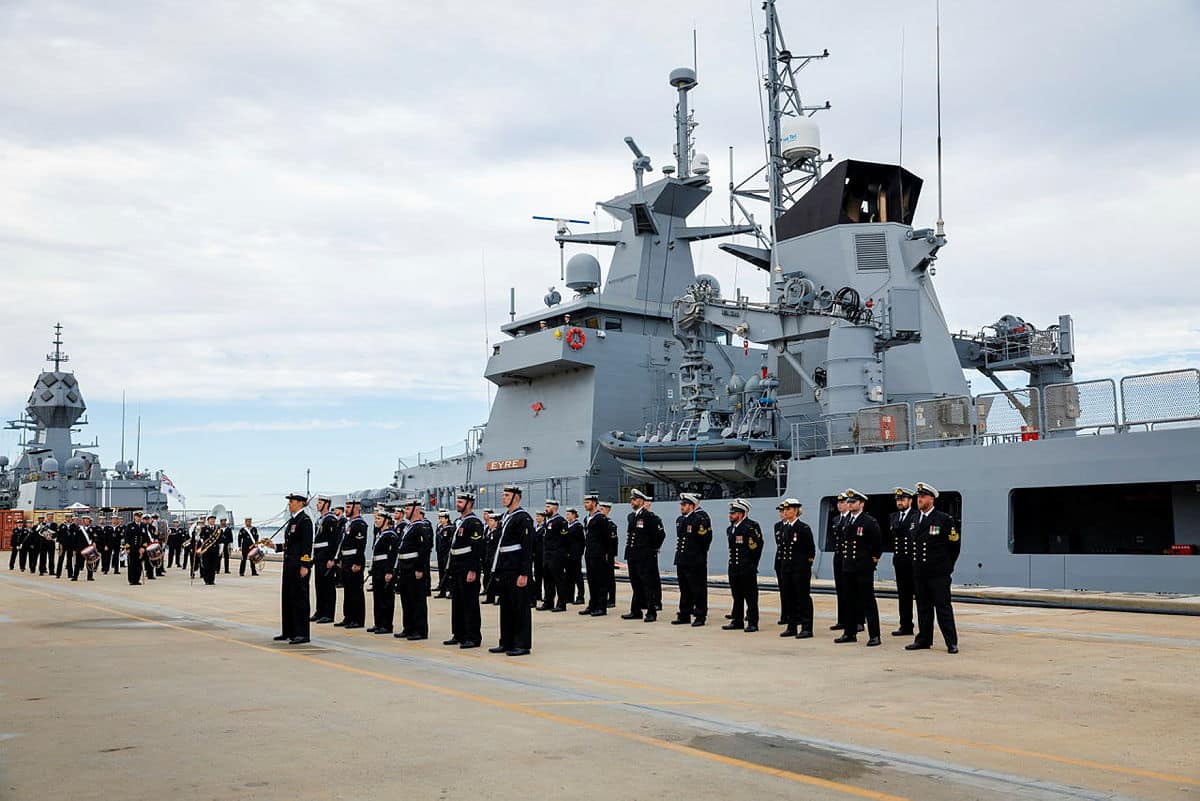
Royal Australian Navy Commissions Second Arafura-Class OPV; Six-Ship Class Enters Operational Service
The Arafura class is a constrained-budget solution to persistent presence — it buys Australia a legal claim to EEZ sovereignty and provides early warning, but it doesn't deter Chinese militia operations or enforce Australia's maritime claims.
If Australia is serious about contested waters in the Timor Sea and approaches to the Great Barrier Reef, it will need to either accelerate OPV production or supplement with corvettes or guided-missile frigates.
The AUKUS submarine commitment (SRF-West by 2027) and the cancellation of Virginia-class buys in favor of SSN-AUKUS suggest Australia is betting on subsurface advantage to offset surface gaps — a reasonable hedge, but one that leaves surface patrol to these lightly-armed OPVs for the next 5-7 years.
Australia is now fielding two of six planned OPVs designed for exclusive economic zone (EEZ) patrol and maritime domain awareness across the Indo-Pacific.
The class represents baseline surface presence in contested waters where China has expanded coast guard and militia operations — but Arafura-class vessels lack the armament and speed to contest surface action with peer competitors.
The real constraint is production cadence: if Australia maintains current delivery tempo (one per 12-18 months), the full class won't be operational until 2031-2033, by which time the threat picture in the South China Sea and Timor Sea will have shifted substantially. Watch the FY27 Australian Defence Force strategic review for any acceleration commitment or gap-fill procurement of more capable hulls.
What is the actual delivery schedule for hulls 3-6? The article states six are planned but provides no timeline. Has Australia committed to accelerating production, or does the 12-18 month cadence hold?
Fault Lines
Strategic intelligence, synthesized daily — with a public track record. Every call graded against what actually happened.