Samsung Displays HBM5 Mockup with Integrated Cooling at Computex; Escalates Thermal Race Against SK Hynix
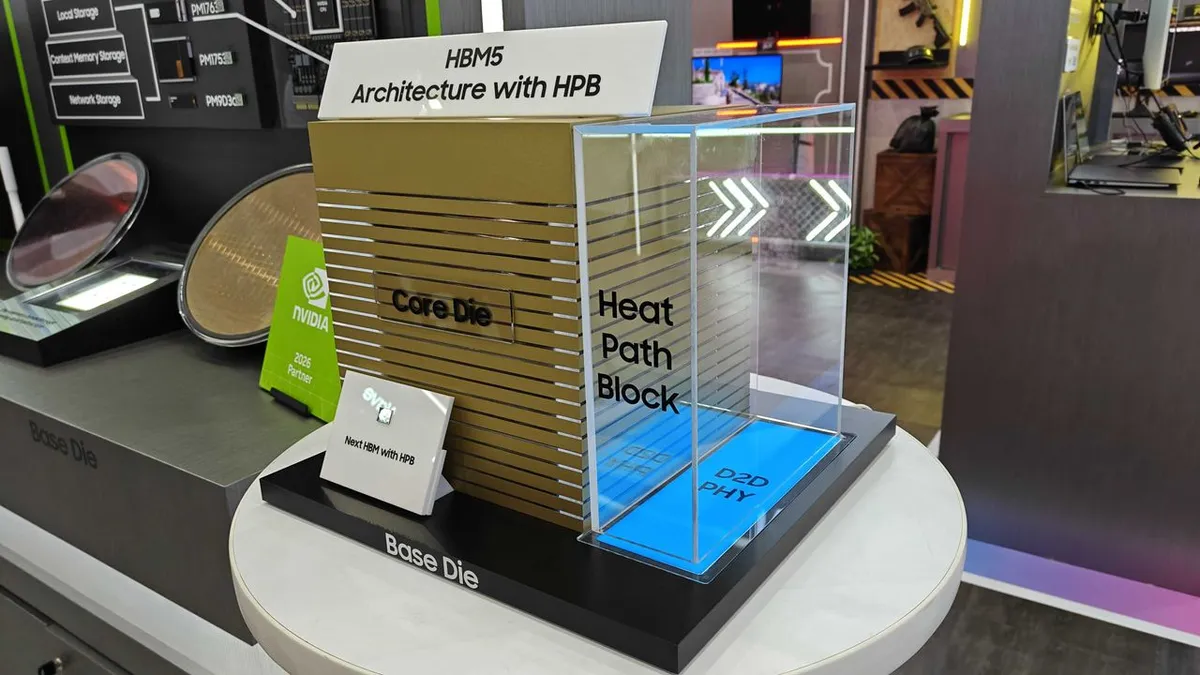
If Samsung closes the thermal gap, it breaks SK Hynix's ability to command 60%+ gross margin on HBM memory. That forces SK Hynix to compete on price or pivot to custom packaging for specific OEMs — exactly the move that erodes their leverage with Nvidia. The second-order effect: US AI companies gain a redundant supply source, which weakens the case for CHIPS Act funding to expand domestic HBM production.
Conversely, if Samsung's yield remains below 40% through 2027, SK Hynix maintains pricing power and the US continues to depend on Korean memory for all large-scale AI infrastructure.
Samsung's mockup signals a race with SK Hynix to establish thermal solutions as a competitive moat in HBM5 — the bottleneck technology for large-scale AI training clusters.
If Samsung's Heat Path Block cooling proves manufacturable at yield, it forces Nvidia, TSMC, and custom AI accelerator makers to qualify Samsung memory in their next-generation designs, fragmenting SK Hynix's near-monopoly on HBM supply. The timeline matters: HBM5 qualification cycles run 12-18 months, meaning Samsung's public display is signaling readiness to OEMs now.
Watch whether Nvidia's next earnings call (late July) includes any mention of Samsung HBM5 sampling or qualification timelines — that's the real indicator of whether this mockup translates into design wins.
Does the Heat Path Block cooling solve the yield problem that has constrained HBM4 production, or is Samsung still facing the same packaging defect rates that kept them as a secondary supplier?
Fault Lines
Strategic intelligence, synthesized daily — with a public track record. Every call graded against what actually happened.