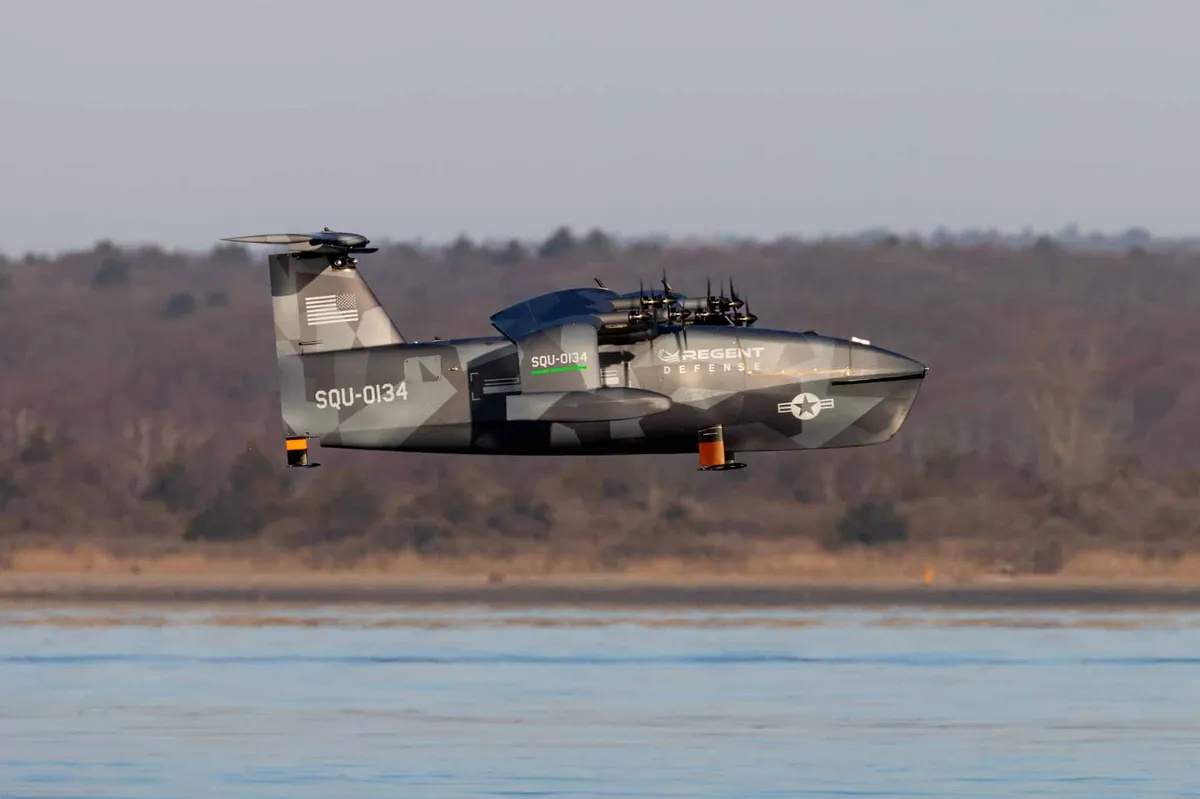
REGENT's Squire Seaglider Clears First Ground-Effect Flight; US Enters WIG Drone Race
The Hormuz blockade (April 13 onwards) created a logistics constraint that traditional air assets cannot efficiently solve — mine-clearing and escort operations require persistent, low-cost surveillance and rapid resupply over 100+ nm of contested water.
A production WIG seaglider with 8-12 hour endurance and 500+ lb payload would displace manned helicopter sorties and reduce the tonnage burden on surface escorts, freeing naval assets for strike or interdict missions.
If REGENT's platform matures before the ceasefire collapses or a new contingency emerges (Taiwan, Arctic), it becomes a procurement priority for CENTCOM and INDO-PACOM — directly competing with Textron's V-247 Warrior and Boeing's MQ-25 Stingray for maritime ISR dollars.
WIG aircraft operate in the aerodynamic boundary layer between sea surface and air, enabling high speed and fuel efficiency for maritime surveillance and logistics over contested waters — precisely the capability gap exposed by the Hormuz blockade now underway.
If Squire reaches production maturity within 18-24 months, it could reduce U.S. Navy dependence on traditional air assets for Strait monitoring and logistics resupply missions, lowering the operational cost of maintaining a blockade or rapid-response posture in the Indo-Pacific.
The timing aligns with CENTCOM's active mine-clearance operations and INDO-PACOM's expanded overflight access via Indonesia — suggesting this is not lab validation but a procurement signal. Key unknown: payload capacity, endurance, and whether this is a surveillance or logistics platform.
The article does not specify payload capacity, operational range, endurance, or target production timeline. It also does not clarify whether this is a one-off prototype or part of a funded development contract, or whether it is intended for Navy procurement or special operations use.
Fault Lines
Strategic intelligence, synthesized daily — with a public track record. Every call graded against what actually happened.