Hegseth Signals Sustained Munitions Supply for Iran Campaign; No Constraint on Firepower
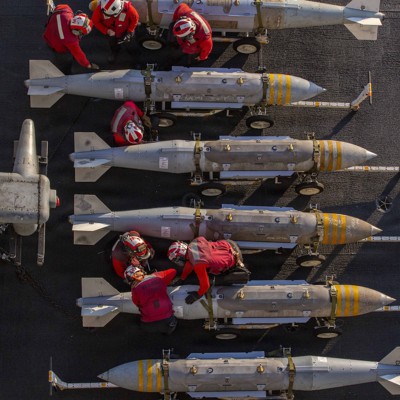
Hegseth's removal of munitions supply as a campaign limiter collapses one constraint on escalation duration and intensity, shifting the conflict's trajectory from logistics-bound to policy-bound.
This directly affects defense prime margin exposure: sustained high-volume munition consumption will accelerate inventory drawdown and trigger replenishment contracts (Tomahawk, JDAM, air-to-air missiles), but only if Congress maintains appropriations and supply-chain partners (solid rocket motor suppliers, guidance system integrators) can sustain production rates without price renegotiation.
Hegseth's assertion that munitions supply is not a constraint removes a potential limiting factor on the duration and intensity of the campaign.
This matters to contractors (RTX, Northrop, General Dynamics) whose production rates and inventory drawdowns will now face sustained demand through at least the next phase of operations. For program managers, this signals that current production capacity is adequate — or that emergency contracting and expedited deliveries are underway — meaning no immediate repricing or delay risk on existing munition contracts.
For policy analysts, the statement indicates the campaign is not self-limited by logistics; escalation or sustained operations depend on political will, not supply chain friction.
The statement does not clarify whether 'no shortage' refers to current inventory, surge production capacity, or both. It does not name which munition types are being prioritized or whether allied munition stocks (UK, France, Germany) are being drawn down.
Fault Lines
Strategic intelligence, synthesized daily — with a public track record. Every call graded against what actually happened.