Navy Commits $900M to Hadrian Automated Factories; Submarine Production Surge Amid Active Hormuz Blockade
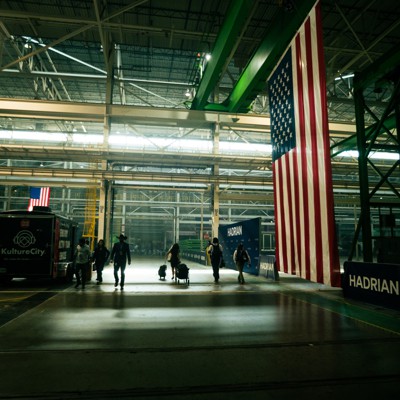
The Hormuz blockade (per prior signals) has cut global oil flow 99% and forced seven nations to organize escort operations. Submarine production acceleration directly supports Pacific deterrence against China and Middle East presence against Iran — but the lag between contract award (now) and operational hulls (2031+) means this investment does not offset current force gaps during the active conflict window.
If Hadrian's automation unlocks production bottlenecks without solving critical mineral or electronics supply constraints, the Navy's ability to surge submarine deployments in the next 18-24 months remains unchanged.
The contract timing is operationally significant: the Navy is accelerating submarine production investment while Hormuz transit has collapsed to near-zero and Iran maintains sustained barrage operations against Israel and U.S. allies.
However, the $900M commitment is a capital investment in *future* capacity, not an immediate increase in deployable hulls. Submarine lead times (typically 5-8 years) mean any production increase from this contract will not affect current or near-term Pacific/Middle East force posture.
The real constraint is not automation but industrial base bottlenecks — if Hadrian's factories solve labor shortages without addressing supply chain disruptions (which the article does not address), production gains may be marginal. Watch whether the Navy discloses target production rates and whether this contract includes penalties for delivery delays or capacity shortfalls.
The article does not specify: (1) how many submarines per year the Navy expects from Hadrian's factories, (2) whether this addresses only Virginia-class or includes Columbia-class SSBN production, (3) what supply chain dependencies remain unresolved, or (4) whether the four-year timeline includes fa...
Fault Lines
Strategic intelligence, synthesized daily — with a public track record. Every call graded against what actually happened.