Chinese EV Exports Through Mexico Expose US Supply Chain to Data Harvesting and Logistics Interception
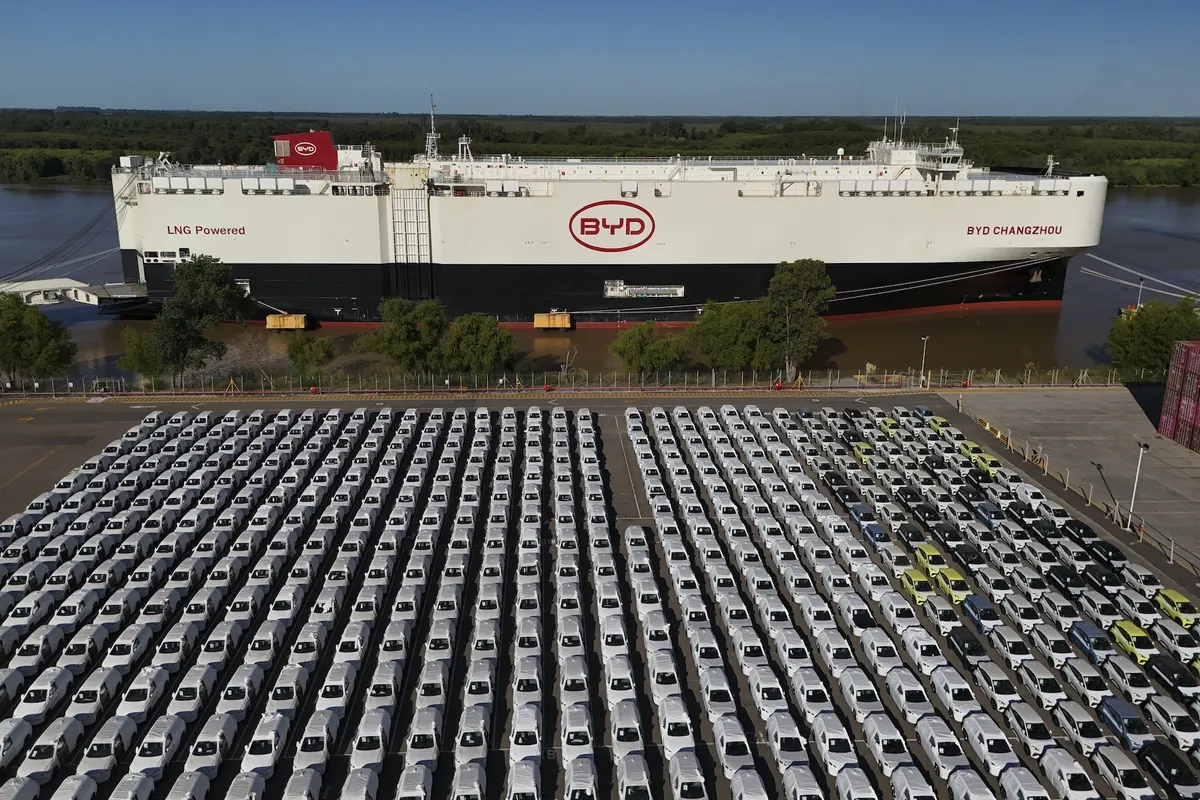
If Chinese EV data collection in Mexico goes unaddressed, it creates a precedent that undermines US control over critical infrastructure intelligence in North America. The second-order effect: other Chinese auto OEMs (BYD, Li Auto, Nio) will replicate the model, accelerating what becomes a de facto Chinese logistics-surveillance network embedded in the North American supply chain.
That network then becomes leverage in a Taiwan contingency — Beijing can threaten to weaponize real-time tracking of US military logistics and defense-contractor movements in Mexico and the Southwest. The third order: this forces a trilateral renegotiation of USMCA data-security provisions, which currently do not address automotive OEM data residency.
This exposes a structural gap in US export control and supply-chain vetting: Chinese automotive companies are routing connected-vehicle platforms into North America via Mexico without clear regulatory friction, creating dual-use vulnerabilities.
Xpeng vehicles collect real-time telemetry, navigation, and user-behavior data; if that data flows to servers outside US jurisdiction, it becomes accessible to Beijing under Chinese national security law — and potentially weaponizable for logistics intelligence (tracking defense-contractor shipments, port operations, military movement patterns).
The mechanism is straightforward: Mexico has no equivalent to CFIUS review or CFATS (Committee on Foreign Investment in the United States) authority over automotive data flows, and no bilateral agreement restricting Chinese OEM data residency. This means every Xpeng sold in Mexico and then re-exported or used as a platform for regional logistics creates a persistent sensor network.
The timeline matters: if Chinese EV penetration in Mexico reaches 10-15% of the market (plausible within 18-24 months given Xpeng's aggressive pricing), that's roughly 200,000-300,000 vehicles annually with persistent uplink to Beijing. Watch whether CFIUS or the Commerce Department issues guidance on automotive data flows from Mexican-based Chinese OEMs by Q4 2026.
Does Xpeng's Mexico operation include a data-processing facility, or does telemetry route directly to servers in China or Hong Kong? If the latter, what is the current legal basis for US Customs to interdict the data flows at the border?
Fault Lines
Strategic intelligence, synthesized daily — with a public track record. Every call graded against what actually happened.