War on the Rocks Authors Call for Empowering Pentagon Personnel in Commercial Acquisition
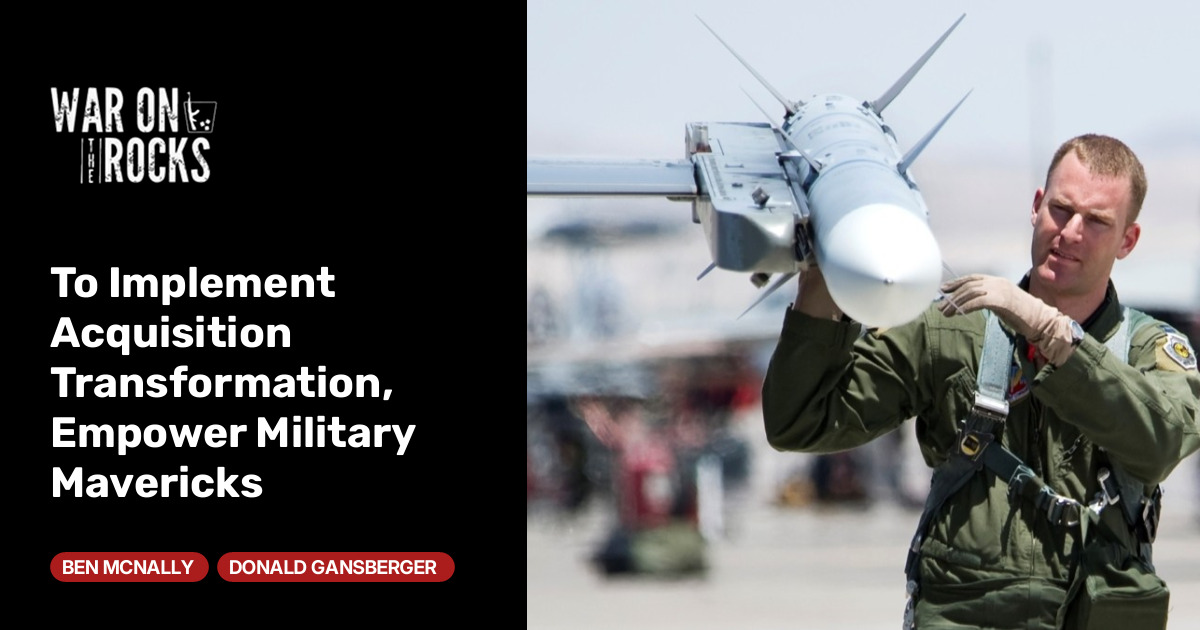
If DIU adopts a weapons-school model without parallel changes to promotion and assignment policy, the Air Force and Navy will continue to treat commercial acquisition tours as career detours rather than credentials. The authors' own evidence supports this: the mavericks who built DIU had training but not incentives, and many left.
A training pipeline that produces experts the services then sideline solves nothing — the constraint moves from knowledge to institutional will to deploy that knowledge.
The Pentagon's Acquisition Transformation Strategy has made commercial-first buying a stated top priority, but the authors identify the binding problem as workforce, not authority: the legal pathways exist and have existed for a decade, yet too few people inside the services know how to use them.
DIU's track record with other transaction agreements since 2016 gives it a curriculum base, but the authors flag that early DIU personnel who built that experience often paid career costs for it — meaning incentive reform must accompany any training model or the pipeline will drain as fast as it fills.
What is the current ratio of DIU-trained acquisition personnel who return to service billets versus those who leave the military or move to industry — and does the Pentagon's Acquisition Transformation Strategy include any career-incentive provisions, or only procedural ones?
Fault Lines
Strategic intelligence, synthesized daily — with a public track record. Every call graded against what actually happened.