Five Japan-Based Destroyers and Carrier George Washington Deployed to Iran; Pacific Deterrence Hollowed
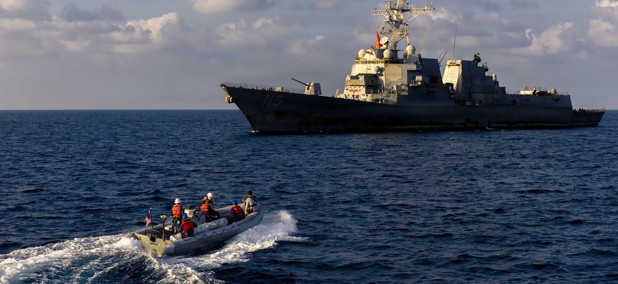
The U.S. Navy's Japan-based force structure has fractured under competing demands. Five of ten destroyers homeported in Yokosuka, plus the carrier George Washington—representing half of the forward-deployed carrier capacity in the Pacific—are currently assigned to U.S. Central Command operations against Iran, with crews notified of deployments extending through 2027.
This allocation reflects a hard constraint: the Navy lacks the hull count to maintain both the Indo-Pacific presence promised in Trump administration strategy documents and the force levels required for sustained Iran operations that began in February 2026. The mechanism is not mysterious—it is arithmetic.
Two carrier battle groups cannot occupy the same waters, and rotational relief cycles assume a predictable tempo of 18-24 months at home station between deployments. Once that cycle breaks, the Navy faces a binary choice: accept reduced presence in one theater or cannibalize rotations from the Atlantic or Mediterranean fleets, each of which carries its own alliance commitments.
The second-order effect materializes through allied planning cycles, not military operations. Japan and South Korea have structured carrier visit schedules, port infrastructure allocations, and joint exercise calendars around the assumption of two carrier rotations per year in the western Pacific.
Defense One's source notes that allies "have been planning months in advance for carrier visits." When those visits evaporate—not because of a tactical setback but because the ships are committed elsewhere—allied defense planners must either absorb the uncertainty or begin hedging by accelerating indigenous naval construction or deepening security partnerships outside the U.S. framework.
The credibility cost is not rhetorical; it is transactional. If Japan cannot rely on the carrier presence it has structured its force posture around, the justification for restraint on indigenous carrier development or for forward-positioning U.S. munitions stocks on Japanese territory weakens.
The window of acute strain runs from now through mid-2027, coinciding with the highest-tempo period for PLA exercises around Taiwan, precisely when allied confidence in U.S. commitment is most consequential.
The forcing event is the FY27 supplemental budget cycle. PACOM will either formally request emergency rotations from Atlantic or Mediterranean squadrons—a request that admits the Indo-Pacific priority is subordinated to Iran operations—or accept a 12-18 month gap in forward-deployed carrier presence.
Half of the Navy's Japan-based destroyer force and the carrier George Washington are deployed to Iran through 2027, breaking the rotational cycle that underwrites allied defense planning in the western Pacific and creating a 12-18 month window where forward-deployed carrier presence drops from two to one.
This contradicts the Trump administration's stated Indo-Pacific priority and exposes the Navy's lack of reserve capacity to execute both theaters simultaneously.
Japan and South Korea have built carrier visit schedules and joint exercise calendars around the assumption of predictable rotations; the cancellation of those visits forces allied planners to either absorb strategic uncertainty or pursue indigenous alternatives to U.S. commitment.
The decision point arrives in the FY27 supplemental: PACOM must either request emergency relief from other fleets—admitting the two-theater strategy is unsustainable—or accept reduced presence in the Pacific during the highest-tempo PLA exercise period around Taiwan.
Watch whether PACOM submits a formal rotation relief request to SECNAV and whether allied defense ministers begin accelerating indigenous carrier or advanced frigate programs in response to the deployment extension.
What is the actual planned redeployment date for the George Washington and the five destroyers—is 2027 a hard date or a placeholder? And has PACOM submitted a formal request to SECNAV for rotation relief from Atlantic or Mediterranean squadrons?
Fault Lines
Strategic intelligence, synthesized daily — with a public track record. Every call graded against what actually happened.