Anduril's Armed Drone Wingmen Enter Captive-Carry Testing Phase
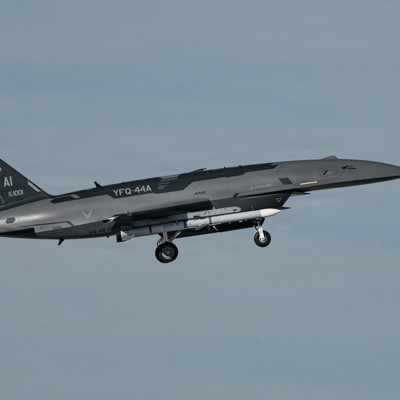
Anduril's progress on weapons integration directly affects the Air Force's force structure decisions for Pacific Command. If captive-carry testing validates the CCA design, the service will accelerate procurement quantities and shift sustainment budgets from legacy drone platforms (MQ-4C, MQ-9) toward autonomous wingman logistics, freeing pilot-hour budgets for manned fighter training.
Conversely, any integration delay past Q3 2026 will force the Air Force to request additional F-35 Block 4 deliveries in FY27-28 to fill the gap, competing for industrial capacity at Lockheed Martin and delaying allied co-production orders from Japan and South Korea.
Captive carry is a gating milestone: it validates airframe structural integrity, sensor fusion, and fire-control integration before any autonomous weapons release occurs.
For Anduril, this de-risks the path to full-rate production contracts and validates the CCA business case against competitors (Kratos, General Atomics). For the Air Force, it accelerates the timeline toward operational CCAs in the Pacific theater — currently estimated at 2027-2028.
The critical uncertainty is whether captive-carry data surfaces integration problems that delay live-fire testing; any 6+ month slip pushes operational availability past near-term Taiwan contingency windows, forcing the service to rely on manned F-35 and F-15EX assets longer than planned.
The article does not specify how many captive-carry sorties are planned, what the success criteria are for advancing to live-fire testing, or whether this test schedule is on track for the 2027-2028 operational timeline cited in prior Air Force statements.
Fault Lines
Strategic intelligence, synthesized daily — with a public track record. Every call graded against what actually happened.