Japan Accelerates Sakura-Class OPV Procurement; 12-Ship Fleet Targets China Maritime Encroachment
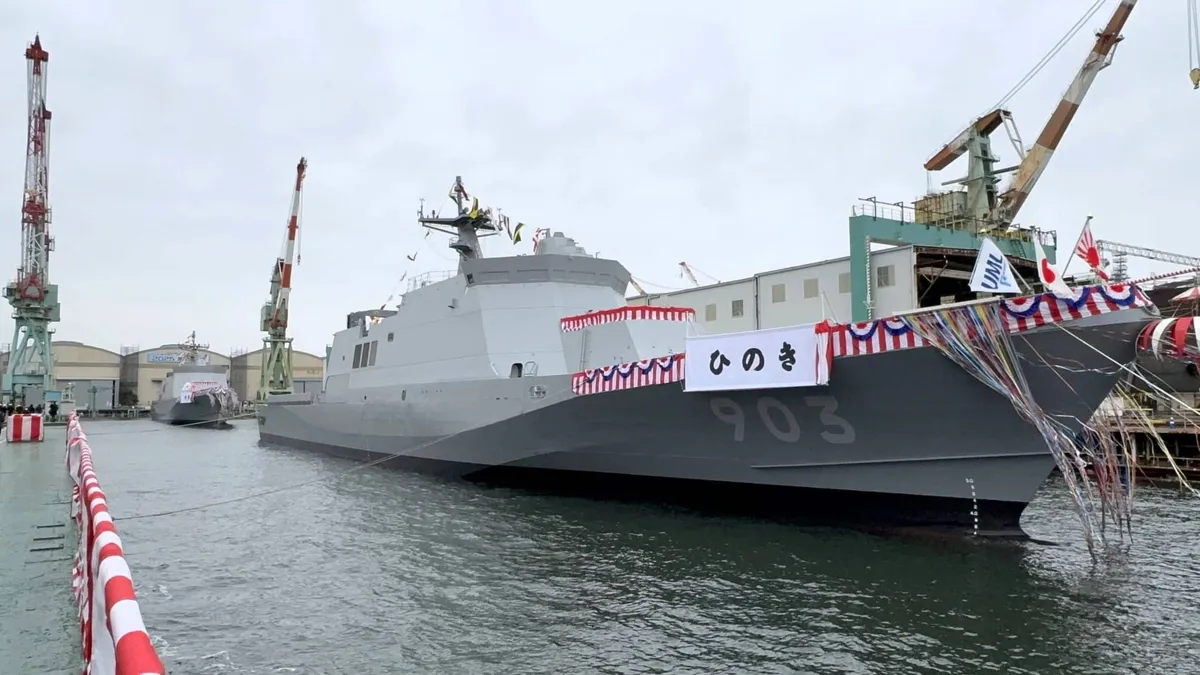
Japan's acceleration of OPV production reinforces the Indo-Pacific alliance's shift toward distributed, lower-cost maritime surveillance to counter China's numerical superiority in coast guard and naval vessels.
This procurement model—short-cycle, serial production of smaller, networked platforms—creates a template for allied navies facing China's gray-zone tactics, but only if these vessels are equipped with real-time data-sharing and integrated into a common operating picture with US and allied systems.
If the Sakura-class remains Japan-only with no allied integration, it becomes a unilateral capacity play that does not change China's calculus on maritime coercion.
Japan is moving from episodic procurement to sustained serial production of a dedicated China-containment asset.
This signals confidence in budget sustainability and a shift toward distributed, lower-cost maritime presence over large surface combatants—a model allied navies (Australia, South Korea, Philippines) are also adopting.
The 12-ship target, if achieved on schedule, creates a persistent surveillance network in the East China Sea and around the Senkaku Islands that raises the operational cost of Chinese gray-zone operations.
However, the article does not specify delivery timelines, unit cost, or whether these vessels carry offensive capability—critical details for assessing whether this addresses the capability gap or merely extends reaction time.
The article omits delivery timeline, unit cost, armament configuration, and whether these vessels integrate into a broader allied maritime architecture (e.g., interoperability with US Navy or Australian patrol assets).
Fault Lines
Strategic intelligence, synthesized daily — with a public track record. Every call graded against what actually happened.