PLA's Sichuan Successfully Launches and Recovers UCAV by Catapult, Claims World First in Drone Carrier Development
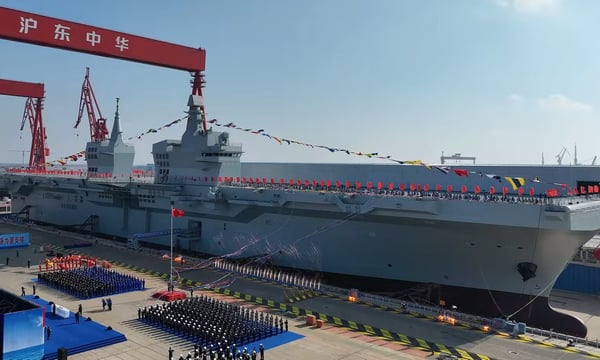
If the Sichuan's UCAV capability is operationally validated, China gains a platform that can project strike drones from an amphibious hull — meaning a Taiwan contingency force could include organic air cover without drawing from carrier aviation.
That shifts the calculus for US strike planning against a PLA amphibious group, because neutralizing the air threat now requires targeting a ship class previously treated primarily as a troop transport.
The article notes South Korea is planning drone carriers and France, Italy, Spain, and the UK are integrating UAS into existing carriers, so the Sichuan test accelerates a competition that will force every Pacific and European navy to reassess how they classify and target amphibious assets.
INDOPACOM planners now face a Chinese platform that pairs amphibious assault capacity with organic fixed-wing UCAV strike reach, a combination the US Navy has no direct equivalent for in the Pacific.
The GJ-21's estimated weight of over 10 tons means the Sichuan can operate a reconnaissance-strike drone that lighter-deck carriers like Turkey's Anadolu cannot, and the electromagnetic catapult — technology China had previously reserved for the Fujian carrier — narrows the gap between China's amphibious and carrier aviation fleets.
The absence of released imagery leaves the operational claim unverified, and the article notes no footage has been published, unlike the Fujian's 2025 catapult debut.
Has the PLA released any imagery or sensor data confirming the GJ-21 launch and recovery, or does the October 30 announcement rest solely on a military press statement with no independent corroboration?
Fault Lines
Strategic intelligence, synthesized daily — with a public track record. Every call graded against what actually happened.